Research Notes: Scholarly Frameworks for Historical Celestial Broadsheet Analysis#
Purpose: Methodology research for the Chronos Archive signal/noise section. Constraint: These notes complement — NOT duplicate — 12-NHI §4.3’s coverage of Vallée’s Magonia thesis. 12-NHI covers Vallée’s cross-cultural visitation thesis, ETH demolition, and 6-layer model. These notes focus on broadsheet-specific scholarly frameworks. Date compiled: 2026-06-18
1. Jacques Vallée: The “Stock Myth” / Propaganda Hypothesis (Broadsheet-Specific)#
Source#
Vallée, Jacques, and Chris Aubeck. Wonders in the Sky: Unexplained Aerial Objects from Antiquity to Modern Times. New York: Tarcher-Penguin, 2010 (orig. 2009), p. 125.
Vallée’s Specific Claim Re: Broadsheets#
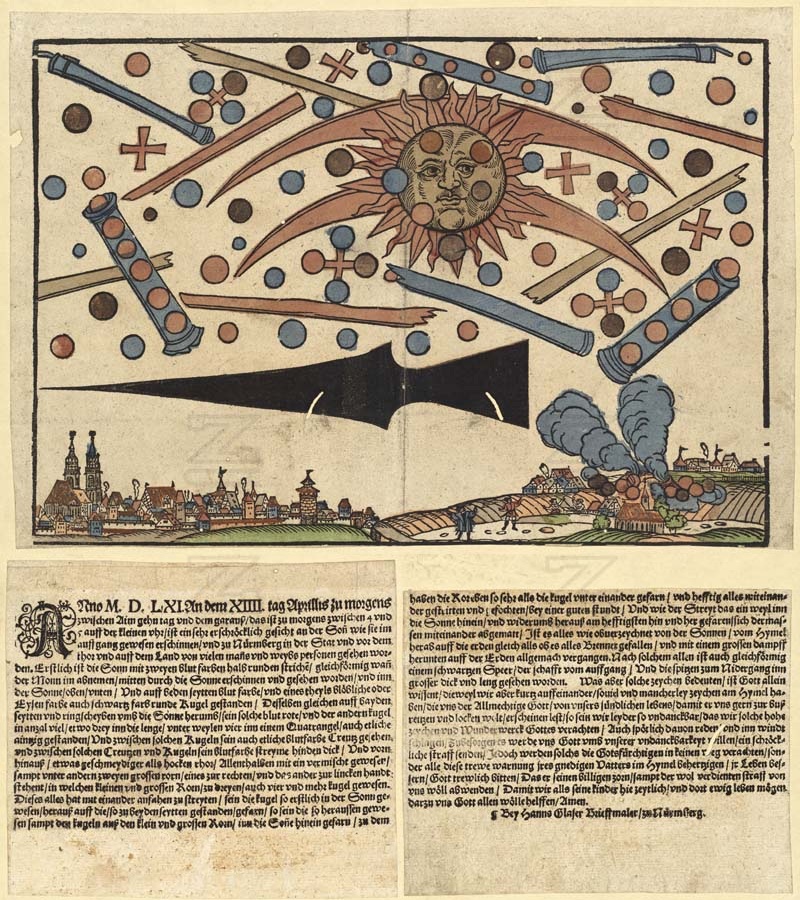
Vallée expresses skepticism over the Nuremberg celestial event (1561) and other 16th-century European celestial events. His reasoning is structural: the similarity between this event and other near-identical events implies a “stock myth” that was “propagated and perhaps commissioned by religious authorities.”
“Ufologist Jacques Vallée expresses skepticism over the Nuremberg celestial event and other celestial events in 16th century Europe. He reasons that the similarity between this event and other near-identical events implies that this may be a ‘stock myth’ propagated and perhaps commissioned by religious authorities. Vallée interprets the admonitions and apocalyptic thinking in Glaser’s prose as evidence that the broadsheet’s purpose is that of propaganda.”
— Cited in Wikipedia and multiple secondary sources, ultimately sourcing to Vallée & Aubeck, Wonders in the Sky, p. 125.
What This Adds Beyond 12-NHI §4.3#
12-NHI §4.3 covers Vallée’s Passport to Magonia (1969) cross-cultural thesis, his 1990 “Five Arguments Against ETH,” and the 6-layer model (2003). It does not cover Vallée’s specific treatment of broadsheet events as potentially commissioned propaganda. The “stock myth” hypothesis is distinct from the Magonia thesis: it does not claim the phenomenon is real-but-adaptive; it claims the broadsheet record may be institutionally manufactured.
Key Implications for Signal/Noise Methodology#
- Vallée — who is otherwise sympathetic to anomalous aerial phenomena — applies a source-criticism filter to broadsheets that he does not apply uniformly to all historical reports.
- His criterion: narrative standardization across independent broadsheets = evidence of a recycled template, not independent witness testimony.
- The mechanism he proposes is institutional commissioning by religious authorities, making these sources analogous to state propaganda rather than folk testimony.
2. Ulrich Magin: Broadsheets as Composite Fabrications#
Source#
Magin, Ulrich. “Ein Ufo im Jahr 1561?” PDF document, published via ufo-information.de, 4 September 2012. Accessible at: https://www.ufo-information.de/index.php/aktuelles/weblog/233-ufos-nuernberg
Magin’s Core Arguments#
(a) Internal Discrepancies in the Artwork#
Magin identifies historical and chronological inconsistencies in Hans Glaser’s woodcut that undermine its value as an objective report:
- Missing Nuremberg Castle: The Kaiserburg, the defining landmark of Nuremberg in Glaser’s time, is absent from the woodcut.
- Anachronistic church: The woodcut depicts a church in flames. Magin initially identified this as St. Leonhard, which had burned down in 1508 and was not rebuilt until 1560 — but the woodcut actually depicts St. Lorenz, which was intact at the time. (Note: Wikipedia corrects this, but Magin’s broader point — that the woodcut conflates multiple historical moments — stands.)
“Die historischen wie chronologischen Diskrepanzen in dem Holzschnitt stärken laut Magin die Vermutung, dass das Nürnberger Flugblatt mehrere, zu unterschiedlichen Zeiten stattgefundene Ereignisse und natürliche Himmelsphänomene miteinander vermischt.”
— German Wikipedia, citing Magin, “Ein Ufo im Jahr 1561?”
(b) The “Heavenly Armies” (Himmelsheere) Motif#
Magin identifies a recurring literary topos across broadsheets: the apocalyptic riders and “heavenly armies” — two hostile divine hosts battling in the sky until one is defeated, after which the victorious army vanishes miraculously and the report closes with a religious admonition.
“In der Darstellung und dem Bericht Glasers sei außerdem ein häufig wiederkehrendes Motiv zu erkennen: Das der apokalyptischen Reiter und der ‘Himmelsheere’. Dabei geht es um zwei verfeindete Heerscharen göttlicher Herkunft, die am Himmel erscheinen, um dort vor den Augen aller Gläubigen eine wilde Schlacht auszutragen, bis eines der Heere bezwungen ist. Danach verschwindet die Siegerarmee auf wundersame Weise und der Bericht schließt mit einer religiös-belehrenden Ermahnung ab.”
— German Wikipedia, citing Magin.
This motif was widespread in antiquity and the early Middle Ages, distributed in large numbers via broadsheets and woodcuts. The Church interpreted all celestial appearances as “divine wonder-signs” or “warning signs from God.”
(c) The “Sensational Tabloid” Analogy#
Magin and Schwarte conclude that the purpose of these texts was popular religiously-themed reading material, more akin to tabloids than to truthful records.
“Magin and other skeptics, such as Wiebke Schwarte, conclude that the purpose of the text was that of popular religiously-themed reading material, more akin to tabloids than to a truthful record of the event.”
— English Wikipedia, “1561 celestial phenomenon over Nuremberg.”
Literacy Context#
At the time of the Nuremberg broadsheet, literacy was estimated at ~30% in males and nearly zero in females. The readership may have been aware they were not meant to treat the broadsheet as a valid documentary record.
3. Wiebke Schwarte: The Broadsheet Tradition as Institutional Manipulation#
Source#
Schwarte, Wiebke. Nordlichter: Ihre Darstellung in der Wickiana. Münster: Waxmann, 1999. ISBN 3-89325-785-3. Relevant pages: 7–9, 23–26, 88–99.
Schwarte’s Core Arguments#
(a) Broadsheets as Church-Commissioned Admonitory Writings (Mahnschriften)#
Schwarte argues that broadsheets reporting “wonder-signs” (Wunderzeichen) should be treated with extreme caution. They were rarely spontaneous popular productions; they were typically church-commissioned admonitory writings whose purpose was religious instruction and social control, not empirical documentation.
“Es sei wenig ratsam, die darin enthaltenen Berichte wörtlich zu nehmen, da es sich meist um von der Kirche in Auftrag gegebene Mahnschriften handelt. Ihr Sinn und Zweck war weniger wissenschaftliche Aufklärung, sondern vielmehr kirchliche Propaganda und Manipulation, und ihre Popularität wurde von der Kirche ausgenutzt. Das Anhalten zur Umkehr und zum Bekenntnis lasse sich gut aus den mahnend-belehrenden Abschlusstexten herauslesen.”
— German Wikipedia, “Nürnberger Flugblatt von 1561,” citing Schwarte, Nordlichter, pp. 23–26.
(b) The Tabloid/Boulevard-Zeitung Analogy#
Schwarte explicitly compares early modern Wunderzeichen broadsheets to modern tabloid newspapers (Boulevard-Zeitungen):
“Frühneuzeitliche Flugblätter wie das Nürnberger Flugblatt seien daher teilweise eher mit heutigen Boulevard-Zeitungen zu vergleichen.”
— German Wikipedia, citing Schwarte, Nordlichter, pp. 23–26.
The exaggerated event descriptions and unnecessary poly-scenic depictions, while hinting at natural phenomena, are themselves so overwrought that they signal a non-documentary purpose.
(c) The Northern Lights Parallel#
Schwarte’s specialized contribution is her analysis of how aurorae were reported in the Wickiana collection. Northern lights were viewed in Central Europe until the late 18th century as “terrible warning signs from God” (schreckliches Mahnzeichen Gottes).
Reports from Basel, Nuremberg, Milan, and Strasbourg describe aurorae using the same narrative schema as the Nuremberg 1561 broadsheet: “heavenly armies fighting” and “fiery glow,” with texts closing in Christian-biblical admonitions.
“Auch Nordlichter wurden in Mitteleuropa bis ins späte 18. Jahrhundert als ‘schreckliches Mahnzeichen Gottes’ betrachtet. Da das Nürnberger Flugblatt von 1561 in einer Zeit entstand, in der augenscheinlich sehr viele ‘Wunderzeichen am Himmel’ beobachtet wurden, ist es für Historiker wenig verwunderlich, dass auch die Berichte über Nordlichter … ebendiese mit ‘am Himmel kämpfenden Heerscharen’ und ‘feurigem Glanz’ umschreiben und die Texte mit christlich-biblischen Mahnschriften abgeschlossen werden. Dieses Schema decke sich gut mit dem Nürnberger Flugblatt.”
— German Wikipedia, citing Schwarte, Nordlichter, pp. 88–99.
Implications for Source Reliability#
Schwarte’s framework means that even when a broadsheet references a real natural phenomenon (e.g., an actual aurora or halo), the report is structurally compromised by its mandatory religious framing, exaggeration, and institutional commissioning. The natural phenomenon is a substrate; the broadsheet is a homiletic superstructure.
4. The Broadsheet Tradition as Cultural Phenomenon#
Genre: Wunderzeichen (Wonder-Signs)#
German broadsheets in the Holy Roman Empire conveyed all manner of wondrous phenomena through woodcuts: “anomalies in the sun, moon, stars … stones and fire falling from the sky, rainbows, miraculous births, rains of blood.” Between 1550 and 1559 alone, more than 400 broadsheets and tracts were published recording these prognostic events.
“Between 1550 and 1559 alone, there were more than four hundred broadsheets and tracts published that recorded these prognostic events.”
— Public Domain Review, “Signs and Wonders: Celestial Phenomena in 16th-Century Germany.”
The Reformation Context#
The genre cannot be separated from the Reformation-era religious anxiety that created mass demand for omens:
“By 1560, [clerical] attention to the unusual had become nothing less than an obsession.” — Robin Bruce Barnes.
“We see the Sun to be darkened and the Moon, the stars to fall, men to be distressed, all the winds and waters to make a noise… How many other Signs also, and unusual impressions, have we seen in the Heavens, in the Sun, Moon, Stars, Rain-bows and strange Apparitions, in these last four years?” — Martin Luther, sermon on the Second Coming.
— Public Domain Review.
Philip Melanchthon (1497–1560), who systematized Luther’s theology, explicitly interpreted celestial scenes as communications from God.
Media Ecology#
Broadsheets were the “tabloids of the sixteenth and seventeenth centuries” (Olson, R.J.M., Historical Comets Over Bavaria, Cambridge/IAU). They operated in a competitive market where publishers vied to produce the most vivid interpretations. The genre of Neue Zeitungen — brief vernacular pamphlets reporting single events — had adopted the compact format and cheap pricing that made Reformation literature accessible.
“Illustrated broadsheets, another format popularized during the Reformation, became vehicles for news as well. Together they reported on wars and treaties, but also disasters, celestial signs, and sensational crimes. To attract buyers, publishers marketed their wares not primarily as novel but as truthful, citing eyewitnesses and trustworthy correspondents.”
— University of Chicago Library, Media Revolutions Then & Now.
The Wickiana Collection#
The Wickiana (Zentralbibliothek Zürich) is the most significant surviving collection of 16th-century broadsheets, assembled by Johann Jakob Wick (1522–1588), a Zurich pastor and archdeacon. It contains 439 prints documenting natural events, monstrous births, crimes, and celestial phenomena. Wick and his contemporaries interpreted these as harbingers of the Last Judgment.
“Die Sammlung kann als Reflex auf das Krisenbewusstsein in einer Zeit konfessioneller und politischer Unsicherheit verstanden werden. Huldrych Zwingli sah das Weltende unmittelbar bevorstehen. Die Nachrichten dürften von Wick und seinen Zeitgenossen als Vorboten des Jüngsten Gerichts gedeutet worden sein.”
— German Wikipedia, “Wickiana.”
Franz Mauelshagen, climate historian and Wickiana scholar, notes: “Fake news existed already in the 16th century.”
The Vädersolstavlan Counter-Example#
The Swedish painting Vädersolstavlan (1535), depicting sun dogs over Stockholm, is critical for source evaluation. It was painted with geometric accuracy and is accepted by scholars as a faithful depiction of a parhelion display. This stands in stark contrast to Hans Glaser’s abstract, mass-produced woodcut, underscoring that 16th-century artists could depict atmospheric optics accurately when they chose to. The difference is genre intent: the Stockholm painting is documentary; the Nuremberg broadsheet is homiletic.
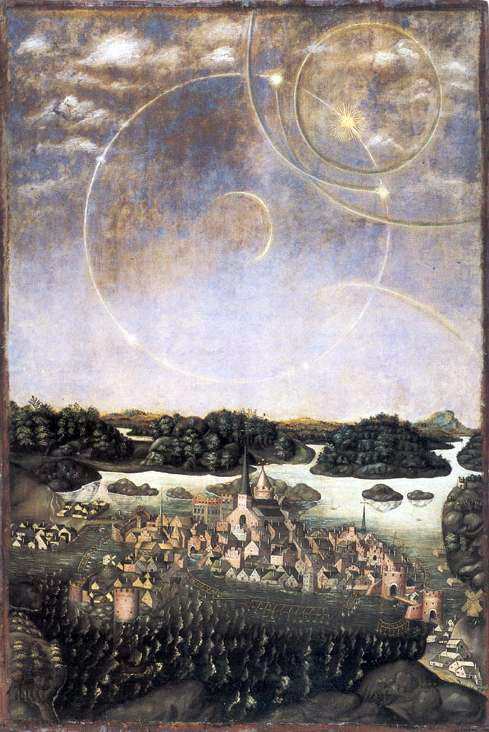


“Sun dogs and related phenomena had been known since antiquity and painted with geometric accuracy in Europe before Hans Glaser’s broadsheet, such as in the famous Swedish painting Vädersolstavlan. This stands in stark contrast to the woodcuts and underscores the purpose of Glaser’s abstract and mass-produced interpretation.”
— English Wikipedia, “1561 celestial phenomenon over Nuremberg.”
5. Atmospheric Optics as Scientific Counter-Explanation#
Overview#
Meteorologists and atmospheric physicists have identified many broadsheet events as depictions of known atmospheric optical phenomena — but not all. The key scholarly task is discriminating which events fit established optics and which resist such explanation.
Phenomena That DO Fit Atmospheric Optics#
(a) Nuremberg 1561: The Frank Johnson Reanalysis#
Source: Frank Johnson. “Nuremburg 1561 UFO ‘Battle’ Debunked.” Ancient Aliens Debunked, 12 December 2012. Archived at: https://web.archive.org/web/20121214172708/http://ancientaliensdebunked.com/nuremburg-ufo-battle-debunked/
Johnson, a UFO skeptic, proposes that the Nuremberg event was a complex parhelion (sun dog) display combined with other atmospheric effects:
- The two “blood-red crescents” = parhelia (mock suns), possibly repositioned behind the sun in the woodcut for compositional reasons.
- The hour-long silent duration = consistent with persistent ice-crystal halos, not transient meteors or aerial combat.
- The large black “spear” = possibly crepuscular rays (Wolkenstrahlen / Dämmerungsschatten) — shadow bands cast by clouds at low sun angles.
- Multiple independent phenomena artistically combined: Glaser mentions an increase in “heavenly wonder-signs” in recent times, suggesting the broadsheet may aggregate several temporally separate events into a single composite scene.
“Auf dem berühmten Nürnberger Flugblatt von 1561 ist nach Ansicht von Meteorologen sehr wahrscheinlich eine morgendliche Halo-Erscheinung inklusive mehrerer Nebensonnen festgehalten. Dafür sprechen gemäß Frank Johnson sowohl die beiden ‘Mondsicheln’, die wohl aus Platzgründen hinter die Sonne gerückt wurden, als auch die Tatsache, dass sich das Ereignis laut Bericht über eine Stunde lang lautlos hinzog. Die große schwarze ‘Speerspitze’ ist möglicherweise auf sogenannte Wolkenstrahlen zurückzuführen.”
— German Wikipedia, “Nürnberger Flugblatt von 1561,” citing Johnson.
Limitations of the parhelion hypothesis: As the Substack analysis The 1561 Nuremberg Phenomenon notes, Glaser’s description of hundreds of spheres, cylinders, and a large triangular form exceeds what typical parhelia produce. Apparent motion (including objects falling to earth) does not match ice-crystal optics, which maintain fixed angular relationships with the sun. The hypothesis explains some features convincingly but struggles with others.
(b) Other Documented Halo Broadsheets#
The meteorological database meteoros.net catalogs numerous broadsheets that are unambiguously accurate depictions of halo phenomena:
| Date | Location | Depicted Phenomena |
|---|---|---|
| 21 March 1551 | Nuremberg | Sundogs, 120° sundog, parhelic circle, “rainbow” halo |
| 16 January 1561 | Rothenburg | Halo phenomenon |
| 5 March 1561 | Nuremberg | Light columns at the moon |
| 12 January 1580 | Nuremberg | ”Three suns and four rainbows” = parhelia, 22° halo, upper tangent arc, supralateral arc, circumzenithal arc, white cross |
| 22 March 1615 | Nuremberg | 22° halo, sundogs, upper tangent arc, 46° halo, circumzenithal arc |
| 19 April 1630 | Nuremberg | 22° ring, sundogs, horizontal circle, circumscribed halo (published by astronomer Mauritius Hubertinus) |
| 19 April 1630 | Nuremberg | 22° ring, sundogs, circumscribed halo, Parry arc, horizontal circle, Wegener’s counter-sun arc |
| 14 February 1645 | Hersbruck (near Nuremberg) | 22° ring, parhelia, upper tangent arc, supralateral arc, circumzenithal arc |
These demonstrate that the broadsheet medium was capable of accurate atmospheric-optics documentation when the producer had documentary intent. The Nuremberg 1561 broadsheet is the outlier in its abstraction.
(c) Stralsund 1665: The Fata Morgana Explanation#
Source: Staatliche Museen zu Berlin. UFO 1665: Die Luftschlacht von Stralsund exhibition, 2023. Curated by Moritz Wullen.
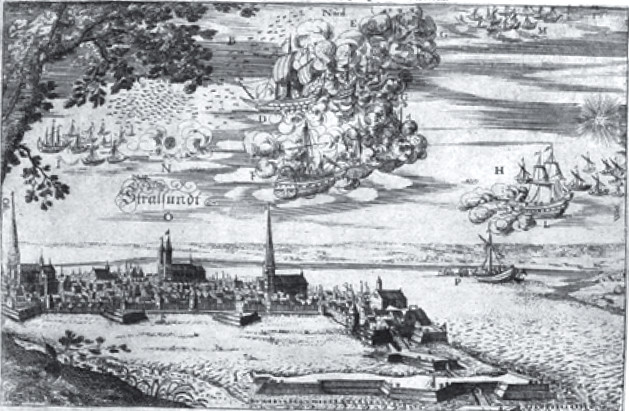

The Stralsund event — six fishermen witnessing aerial warships battling over the Baltic — has been definitively identified by museum scholars as a Fata Morgana (complex atmospheric mirage) projecting a real naval battle occurring beyond the horizon.
“The general public could not have known that what had actually been witnessed was an atmospheric reflection of a sea battle that was raging just beyond the horizon. Instead, they were convinced that the universe was ruled by a god who had the power to project visions of impending disaster into the sky.”
— Staatliche Museen zu Berlin, exhibition description.
This is the strongest case of a broadsheet event fully resolved by atmospheric optics. The fishermen’s subsequent trembling and pain are consistent with prolonged cold exposure and psychological shock, not radiation.
Phenomena That DO NOT Clearly Fit Atmospheric Optics#
(a) Basel 1566: Multiple Competing Hypotheses#
The Basel broadsheet (Samuel Coccius, Samuel Apiarius) describes three separate events in July–August 1566: a blood-red sun and moon, and black spheres fighting before the sun.
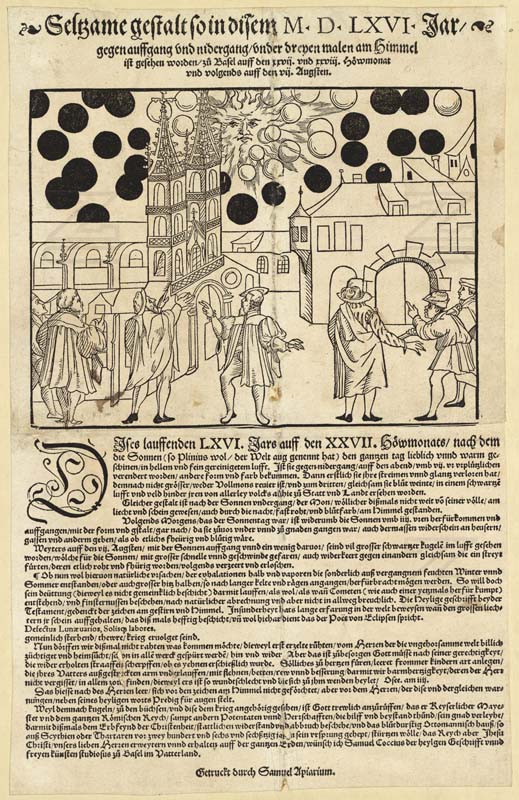

Scholars have proposed:
- Meteor showers
- Bolide (bright meteor/fireball)
- Cometary fragments
- Aurora borealis
- Optical illusions from uncommon atmospheric conditions (e.g., Sahara dust)
- Rare planetary arrangement
No single explanation has achieved consensus. The Swiss National Museum blog (2024) notes: “Historians and scientists, nonetheless, are still left wondering what exactly caused the celestial event over Basel in 1566.”
(b) Nuremberg 1561: The Residual Anomalies#
Even accepting Frank Johnson’s parhelion hypothesis, the following features resist explanation:
- The cylindrical “mother ship” objects from which small spheres emerge
- The falling of combatant spheres to earth in clouds of smoke
- The large black triangular/spear-like object (if not crepuscular rays)
- The apparent directed motion (“fought together”) rather than fixed optical positions
These residuals keep the case in the “unexplained” column for strict signal/noise methodology, even if the majority of the spectacle is atmospherically explicable.
The Ergotism Hypothesis#
Some commentators (e.g., HistoryPod) have proposed city-wide ergotism — hallucinations caused by Claviceps purpurea fungus on rye grain — as an alternative explanation for the Nuremberg event. This is generally dismissed by scholars because:
- Ergotism produces gangrene and convulsions, not coherent shared visual hallucinations
- The event was reported at a specific time and place, not as an ongoing chronic condition
- No medical records of ergotism accompany the broadsheet
6. Synthesis: A Discrimination Framework for Signal/Noise#
Based on the scholarly literature above, the following criteria can be applied to any historical celestial broadsheet:
| Criterion | Signal (Anomalous) | Noise (Conventional) |
|---|---|---|
| Genre identification | No match to Wunderzeichen template | Matches Wunderzeichen / Mahnschrift template |
| Institutional framing | No religious admonition; no call to repentance | Ends with Christian admonition; commissioned by Church |
| Artistic accuracy | Geometrically precise (like Vädersolstavlan) | Abstract, poly-scenic, mass-produced woodcut |
| Internal consistency | Topographical details match known geography | Anachronistic buildings, missing landmarks |
| Atmospheric fit | Resists all known optical explanations | Explained by halos, parhelia, Fata Morgana, aurorae |
| Cross-broadsheet uniqueness | Unique narrative elements | Recycles “heavenly armies” stock motif |
| Witness documentation | Multiple independent corroborating sources | Single broadsheet; no independent verification |
Application to the Archive#
For the Chronos Archive’s purposes, the broadsheet record must be evaluated with extreme skepticism. The scholarly consensus (Vallée, Magin, Schwarte, meteorologists, art historians) converges on the following:
- The broadsheet medium is institutionally compromised. Most Wunderzeichen broadsheets were church-commissioned admonitory writings, not empirical reports.
- The “heavenly battle” motif is a stock myth. Its recurrence across Nuremberg, Basel, and other cities signals a literary topos, not independent verification.
- Atmospheric optics explains many events. The Stralsund 1665 case (Fata Morgana) and numerous halo broadsheets (1551–1645) demonstrate that conventional explanations are available and should be exhausted before anomalous hypotheses are entertained.
- Residual anomalies remain. The Basel 1566 event and specific features of the Nuremberg 1561 description resist single-cause atmospheric explanation. These residuals are the legitimate signal — but they are embedded in a medium so noisy that isolating them requires forensic rigor.
Direct Quotations Summary#
“A ‘stock myth’ propagated and perhaps commissioned by religious authorities.” — Vallée, Wonders in the Sky, p. 125.
“Das der apokalyptischen Reiter und der ‘Himmelsheere’.” — Magin, on the recurring broadsheet motif.
“Ihr Sinn und Zweck war weniger wissenschaftliche Aufklärung, sondern vielmehr kirchliche Propaganda und Manipulation.” — Schwarte, Nordlichter, pp. 23–26.
“Between 1550 and 1559 alone, there were more than four hundred broadsheets and tracts published that recorded these prognostic events.” — Public Domain Review.
“The general public could not have known that what had actually been witnessed was an atmospheric reflection of a sea battle that was raging just beyond the horizon.” — Staatliche Museen zu Berlin, on Stralsund 1665.
“Auf dem berühmten Nürnberger Flugblatt von 1561 ist nach Ansicht von Meteorologen sehr wahrscheinlich eine morgendliche Halo-Erscheinung inklusive mehrerer Nebensonnen festgehalten.” — German Wikipedia, citing Frank Johnson.
Source Bibliography#
- Johnson, Frank. “Nuremburg 1561 UFO ‘Battle’ Debunked.” Ancient Aliens Debunked, 12 December 2012. Web archive.
- Magin, Ulrich. “Ein Ufo im Jahr 1561?” PDF. ufo-information.de, 4 September 2012.
- Olson, R.J.M. “Historical Comets Over Bavaria: The Nuremberg Chronicle and Broadsides.” IAU Colloquium (Cambridge).
- Schwarte, Wiebke. Nordlichter: Ihre Darstellung in der Wickiana. Münster: Waxmann, 1999. ISBN 3-89325-785-3.
- Staatliche Museen zu Berlin. UFO 1665: Die Luftschlacht von Stralsund. Exhibition, 2023.
- University of Chicago Library. Media Revolutions Then & Now.
- Vallée, Jacques, and Chris Aubeck. Wonders in the Sky: Unexplained Aerial Objects from Antiquity to Modern Times. New York: Tarcher-Penguin, 2010.
- Wikipedia (English and German). Entries: “1561 celestial phenomenon over Nuremberg,” “1566 celestial phenomenon over Basel,” “1665 celestial phenomenon over Stralsund,” “Wickiana,” “Nürnberger Flugblatt von 1561.”
- Zentralbibliothek Zürich. Wickiana collection documentation.