CONTROL BASELINE: The 1535 Stockholm Vädersolstavlan (Sun Dog Painting)#
Classification: CONTROL BASELINE — Known Atmospheric Optics Date: 20 April 1535 Location: Stockholm, Sweden Medium: Oil-on-panel (original lost; surviving copy 1636) Analyst: The Chronos Archive, Lead Investigator
Purpose of This Document#
This document establishes the control baseline for the Archive’s analytical framework. The Vädersolstavlan is not an anomalous event. It is a documented, well-understood atmospheric optics phenomenon depicted with geometric fidelity by a 16th-century observer. It defines what “known noise” looks like when rendered by pre-modern artists. Every anomalous event in the Archive must exceed this baseline in specificity, physical impossibility, or cross-source convergence before it qualifies for literal reconstruction.
“This is the baseline against which anomalous events are measured.”
Event Summary#
On the morning of 20 April 1535, between approximately 7:00 and 9:00 AM, a complex halo display appeared over Stockholm. The phenomenon was witnessed by numerous inhabitants and subsequently recorded in both textual accounts and a painted depiction commissioned by the Swedish reformer Olaus Petri.
The painting, known as Vädersolstavlan (Swedish: “The Sundog Painting” or literally “The Weather Sun Painting”), is named after the sun dogs (vädersol) visible in the upper portion. It is chiefly noted for being the oldest color depiction of Stockholm and arguably the oldest Swedish landscape painting and the oldest known depiction of sun dogs.1
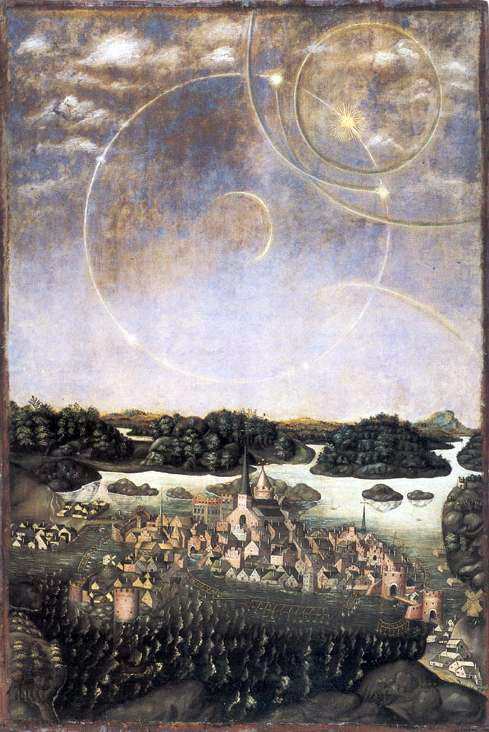

“In the year 1535 A.D. the twentieth of April was seen in the city of Stockholm such a sign in heaven, from the seventh farm, the hour from Noon to the ninth o’clock.” — Inscription on the painting’s frame (Latin, Swedish, German)1
Painting History#
Original (1535)#
The original painting was produced shortly after the event and is traditionally attributed to Urban målare (“Urban [the] Painter”). It is now lost, and virtually nothing is known about its dimensions or precise composition.1
Surviving Copy by Jacob Elbfas (1636)#
The extant painting is a copy from 1636 by Jacob Heinrich Elbfas (1600–1664), court painter to Queen Maria Eleonora. It was long erroneously believed to be the restored original. Dendrochronological examination in 1998–1999 confirmed the panel wood dates to the early 17th century, establishing it as a copy.12
The copy is held in Storkyrkan (Stockholm Cathedral) and measures 163 cm × 110 cm. It was carefully restored in 1998–1999, removing layers of yellowed varnish and overpainting (including a later Prussian blue layer) to reveal the original detail.1
“Modern scholarship has convincingly identified Jacob Heinrich Elbfas… as the artist responsible… A dendrochronological investigation showed that the wood used for the panel came from trees cut down in the early 17th century: the painting in question must therefore be a copy and not the restored original.”1
Atmospheric Optics Depicted#
The upper portion of the painting depicts the halo display with geometric accuracy recognizable to modern atmospheric optics. The artist rendered the sky in an approximately azimuthal or stereographic projection — akin to a modern fish-eye lens — showing the entire sky dome.3
The following optical phenomena are identifiable:134
| Phenomenon | Description in Painting | Modern Identification |
|---|---|---|
| Parhelia (Sun Dogs) | Bright spots flanking the sun at ~22° | Common parhelia from plate-oriented hexagonal ice crystals |
| 22° Halo | Circular ring centered on the sun | Primary halo from randomly oriented hexagonal ice crystals |
| Parhelic Circle | Large white circle crossing the sky horizontally | Reflection halo from horizontal plate crystals; centered on zenith |
| Circumzenithal Arc | Smaller crescent-like arc near the top (zenith) | Refraction arc from plate crystals; often described as “upside-down rainbow” |
| Upper Tangent Arc / Parry Arc | Crossing arcs above the 22° halo | From column-oriented crystals |
| 120° Parhelia | Additional bright spots on the parhelic circle | Rare parhelia from plate crystals |
| Anthelion | Brightening opposite the sun on the parhelic circle | Intersection of Wegener arcs with the parhelic circle |
| Infralateral Arc | Arc visible at lower right | Refraction arc from plate crystals |
“A bright and complete parhelic circle dominates the sky with the sun placed at upper right… Like beads, the real sun and five extra suns are strung around the parhelic circle.”3
The relative brightnesses of the haloes are considered quite accurate by modern standards.4
Scholarly Consensus#
The 1535 Stockholm event is universally accepted by meteorologists, art historians, and atmospheric physicists as a well-documented natural atmospheric optics display. There is no controversy about its nature.13
The painting’s value to science lies in its fidelity: it demonstrates that a 16th-century artist could observe, record, and reproduce complex optical phenomena with sufficient geometric precision that modern halo simulations can be superimposed over the painting with close correspondence.3
“The 1630s replica has proven to be an accurate copy of the lost original… the panorama has proven to be a surprisingly reliable historical document.”1
Meteorological Explanation#
The phenomenon is caused by ice crystal refraction and reflection in cirrus or cirrostratus clouds in the upper troposphere (typically 5–10 km altitude).5
- Hexagonal ice crystals act as prisms and mirrors, refracting and reflecting sunlight.
- Plate-oriented crystals produce sun dogs, the parhelic circle, and the circumzenithal arc.
- Randomly oriented crystals produce the 22° halo.
- Column-oriented crystals produce the upper tangent arcs.
Sun dogs were sufficiently well known in the Middle Ages that they appear in the Old Farmer’s Almanac (Bondepraktikan) as weather omens forecasting strong winds.1
“The ice crystals responsible for halos are typically suspended in cirrus or cirrostratus clouds in the upper troposphere… The particular shape and orientation of the crystals are responsible for the type of halo observed.”5
Control Baseline Significance#
What This Establishes#
The Vädersolstavlan establishes the upper bound of “mundane” accuracy achievable by pre-modern observers:
- Geometric fidelity is possible. A 16th-century artist, working without optical instruments, produced a sky depiction accurate enough to match modern fish-eye projections.
- Natural phenomena can be complex. The display included multiple simultaneous optical effects (parhelia, halos, arcs, circles) that could appear spectacular or ominous to witnesses.
- Religious interpretation does not negate physical accuracy. Olaus Petri interpreted the event apocalyptically, yet the painting itself depicts the optics faithfully.
The Nuremberg Contrast: Glaser’s Woodcut (1561)#
The critical comparison is with the 1561 Nuremberg broadsheet by Hans Glaser, depicting a celestial event of 14 April 1561. Unlike the Vädersolstavlan, Glaser’s woodcut is stylized, sensationalized, and geometrically inaccurate if interpreted as atmospheric optics:67
| Feature | Vädersolstavlan (1535) | Glaser’s Nuremberg Woodcut (1561) |
|---|---|---|
| Geometric accuracy | High — arcs match modern simulations | Low — crosses, cylinders, spears, “aerial battle” |
| Phenomenon depicted | Identifiable halo components | Composite/symbolic imagery; not matching any known optical display |
| Artist’s intent | Documentary (despite religious framing) | Sensational/religious broadsheet (“popular religiously-themed reading material, more akin to tabloids”)6 |
| Relationship to source | Direct depiction of observed event | Likely amalgam of hearsay, religious symbolism, and artistic license |
| Utility to analysis | Baseline for “accurate natural depiction” | Demonstrates what stylized/constructed reporting looks like |
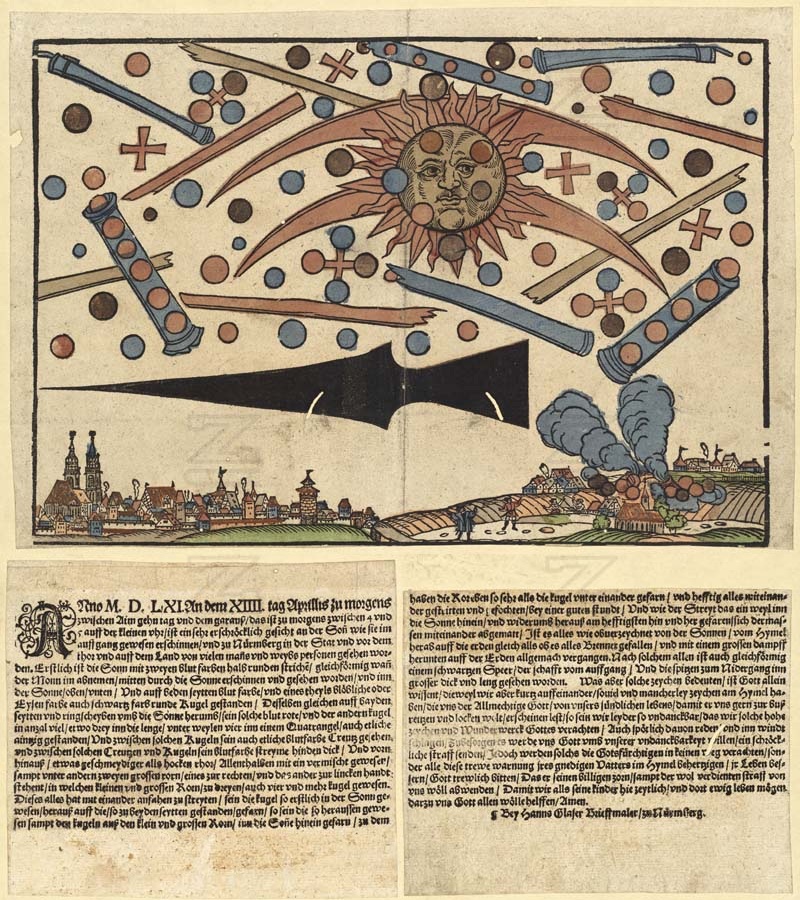
“Sun dogs and related phenomena had been known since antiquity and painted with geometric accuracy in Europe before Hans Glaser’s broadsheet, such as in the famous Swedish painting Vädersolstavlan. This stands in stark contrast to the woodcuts and underscores the purpose of Glaser’s abstract and mass-produced interpretation.”6
Conclusion: The Baseline Rule#
Any event in the Archive claiming anomalous status must exceed the Vädersolstavlan baseline in at least one of the following dimensions:
- Physical impossibility under known natural law (e.g., objects executing right-angle turns at hypersonic speeds, mass-independent acceleration)
- Persistent geometric inconsistency with any known atmospheric, astronomical, or geological phenomenon
- Multi-source convergence across geographically and temporally isolated witnesses describing the same operational detail
- Technological specificity in witness descriptions that exceeds “glowing light in the sky”
The Vädersolstavlan reminds us: spectacular sky phenomena are real, common, and have been accurately recorded for centuries. The Archive’s task is to distinguish the legitimately unexplained from the merely unexplored.
Sources#
Footnotes#
-
Wikipedia contributors, “Vädersolstavlan,” Wikipedia, The Free Encyclopedia, https://en.wikipedia.org/wiki/V%C3%A4dersolstavlan (accessed June 18, 2026). ↩ ↩2 ↩3 ↩4 ↩5 ↩6 ↩7 ↩8 ↩9 ↩10
-
St. Erik’s Cultural Heritage Centre, Vädersolstavlan: The Restoration and Documentation of a 17th Century Painting (Stockholm, 1999). ↩
-
Les Cowley, “Stockholm 1535 halos,” Atmospheric Optics, https://atoptics.co.uk/blog/stockholm-1535-halos/ (accessed June 18, 2026). ↩ ↩2 ↩3 ↩4 ↩5
-
Wikimedia Commons contributors, “File:Vädersoltavlan cropped.JPG,” Wikimedia Commons, description of visible haloes. ↩ ↩2
-
Wikipedia contributors, “Halo (optical phenomenon),” Wikipedia, The Free Encyclopedia, https://en.wikipedia.org/wiki/Halo_(optical_phenomenon) (accessed June 18, 2026). ↩ ↩2
-
Wikipedia contributors, “1561 celestial phenomenon over Nuremberg,” Wikipedia, The Free Encyclopedia, https://en.wikipedia.org/wiki/1561_celestial_phenomenon_over_Nuremberg (accessed June 18, 2026). Citing Ulrich Magin and Wiebke Schwarte. ↩ ↩2 ↩3
-
Hans Glaser, broadsheet, “Prodigious event over Nuremberg, Germany, April 14th 1561,” woodcut, 1566. Zentralbibliothek Zürich. ↩