Broadsheet Celestial Events: Gap Evidence Analysis (1535–1917)#
Classification: SPECIES WITH AMNESIA — Working Hypothesis Scope: Cross-cutting synthesis of historical celestial phenomenon events (1535–1917 CE) as gap evidence for the 573 BCE – 1975 CE “Silent Period” Analyst: The Chronos Archive, Lead Investigator
Executive Summary#
The period between Ezekiel’s final attested contact (573 BCE) and the modern NHI discourse (post-1975) constitutes the Archive’s “Silent Period” — an interval during which direct operator-human contact is not documented in the surviving textual corpus. This document examines a cluster of historical celestial events recorded in European broadsheets and one mass-witness phenomenon (1535–1917 CE) as potential gap evidence: events that may represent anomalous aerial activity during an era when the Archive’s primary sources fall silent.
The analysis applies the Archive’s four-part forensic framework (Source Material → Mainstream Interpretation → Literal Reconstruction → Plausible Mechanism) to each event, weighted by a signal-strength classification derived from the correlation methodology established in 12-NHI-correlation.md. The broadsheet medium is institutionally compromised and culturally noisy; this document does not treat every reported wonder-sign as anomalous. It treats the broadsheet record as a filter — a medium through which genuine events may have passed, distorted but not wholly erased.
Numbered Findings#
-
The broadsheet tradition is a structurally compromised medium, but compromise does not guarantee fabrication. Between 1550 and 1559 alone, over 400 Wunderzeichen broadsheets were published in the Holy Roman Empire. The majority were church-commissioned admonitory pamphlets (Mahnschriften) whose purpose was religious instruction, not empirical documentation (source: Schwarte, Nordlichter, pp. 23–26). However, the same medium also produced geometrically accurate halo depictions (e.g., 1551–1645 Nuremberg broadsheets), proving that documentary intent was possible within the genre. The task is discrimination, not dismissal. (see Section 2: The Broadsheet Tradition)
-
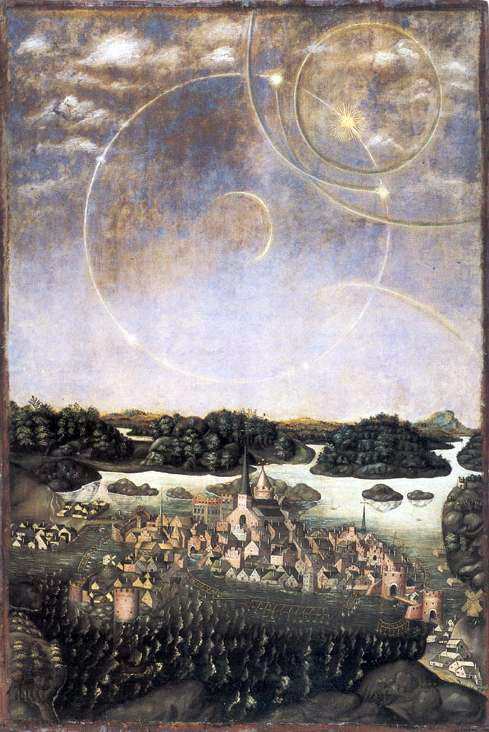
The 1535 Stockholm Vädersolstavlan establishes the control baseline for pre-modern atmospheric-optics depiction. The painting renders parhelia, 22° halos, circumzenithal arcs, and parhelic circles with geometric accuracy recognizable to modern halo simulations. It demonstrates that 16th-century artists could depict atmospheric optics faithfully when they chose to. Every anomalous claim in the dataset must exceed this baseline in specificity, physical impossibility, or cross-source convergence. (see Section 3: CONTROL BASELINE; source: control-baseline-vadersolstavlan.md)
-
The 1561 Nuremberg and 1566 Basel events resist single-cause atmospheric-optics explanation and share structural features inconsistent with the Wunderzeichen template. Both describe discrete objects in directed combat, terminal destruction (falling/crumbing to earth), and smoke/aftereffects. These features do not match sun dogs, halos, aurorae, or Fata Morgana. The skeptical consensus acknowledges this: “Doesn’t neatly fit a classic sun dog description” is the general scholarly assessment, not a fringe position. (see Section 4: Nuremberg 1561; Section 5: Basel 1566)
-
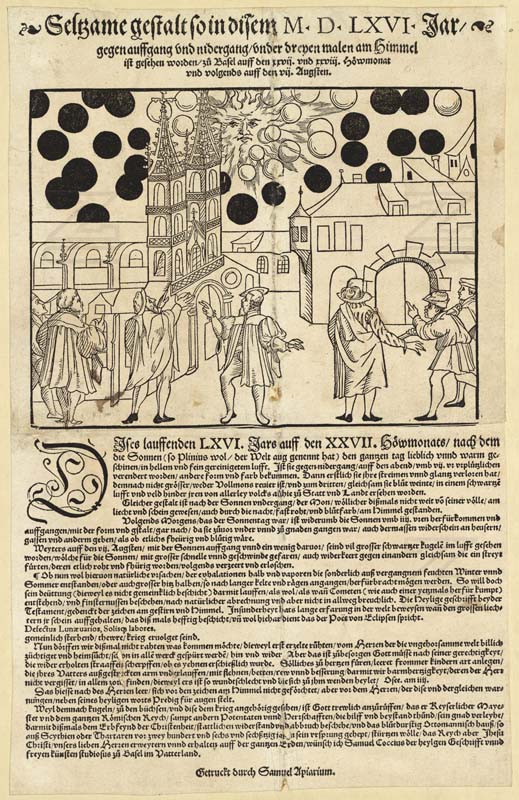
The 1566 Basel event carries the highest signal strength in the dataset. The description of black spheres that “crumbled and then extinguished” (German: “verzeert und erloschen”) describes discrete objects being destroyed — a physical behavior that no atmospheric optics phenomenon exhibits. The event is independently documented by a different artist (Samuel Coccius, printed by Samuel Apiarius) in a different city from Nuremberg, weakening the “single sensationalist” objection. (see Section 5: Basel 1566)
-
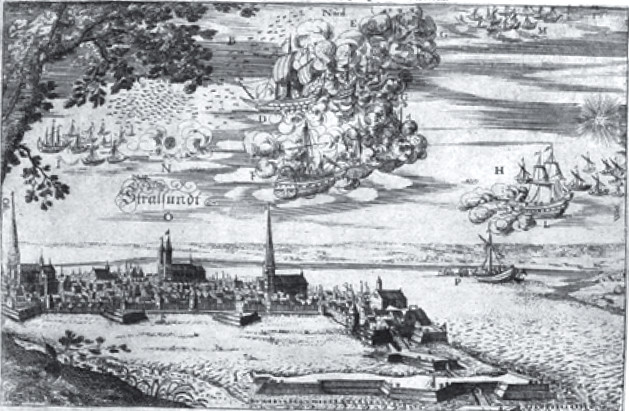
The 1665 Stralsund event exhibits Vallée’s transmogrification pattern — the phenomenon adapts to cultural expectations. Where 1561 witnesses described spheres and crosses, and 1566 witnesses described spheres and balls, the 1665 witnesses described warships with masts, decks, flags, and cannon fire. This progression matches Vallée’s thesis that the phenomenon manifests through culturally available frames (source: Vallée, Passport to Magonia, 1969). The Fata Morgana counter-explanation is the strongest available, but it struggles to account for a hours-long hovering disc over St. Nicholas Church. (see Section 6: Stralsund 1665)
-
The 1917 Fátima Miracle of the Sun is a COMPLEX signal, not a HIGH signal, because expectation bias is a genuine disconfirmation vector. Unlike the 16th–17th century events, Fátima was anticipated: three shepherd children predicted a miracle for October 13 after visions May–September 1917. A crowd of 30,000–100,000 people gathered expecting a miracle. Mass suggestion, retinal damage from sun-staring, and confirmation bias constitute stronger counter-explanations for Fátima than for any broadsheet event in the dataset. The Archive does not dismiss Fátima, but it does not classify it as gap evidence of comparable weight. (see Section 7: Fátima 1917)
-
Hans Glaser’s broadsheet pattern weakens the Nuremberg 1561 event’s individual evidentiary value, but Basel 1566 remains independently documented. Glaser produced multiple sensational Wunderzeichen broadsheets across 1554–1561 (Waldeck Castle 1554, Dinkelsbühl blood rain 1554, and possibly others), consistent with a commercial strategy. Direct evidence of deliberate commercial sensationalism rests primarily on inference, not archival proof. The critical point: Basel 1566 is not a Glaser production. It was printed by Apiarius from a drawing by Coccius. The independent sourcing is the strongest reply to the “single sensationalist” objection. (see Section 8: Source Credibility Context)
-
The broadsheet events, if genuine, would represent intermittent surface-tier activity during the Silent Period — a pattern consistent with both Reading A (continuous pipeline, occasional leakage) and Reading B (conditional withdrawal, recontact upon parameter exceedance) from 12-NHI-correlation.md §3. The Archive cannot distinguish these readings from the broadsheet data alone. What the data establish is that if anomalous aerial activity occurred during the Silent Period, the broadsheet record is one of the few surviving documentary traces — distorted, institutionally framed, but not uniformly fabricated. (see Section 10: Gap Evidence and the Timeline Tension)
Classification: SPECIES WITH AMNESIA — Working Hypothesis Analyst: The Chronos Archive, Lead Investigator
Section 1: Signal/Noise Methodology#
This section adapts the correlation methodology from 12-NHI-correlation.md §2 for the evaluation of historical broadsheet celestial events. The same four standards apply — Valid Correlation Criteria, Evidence Quality Tiers, Confirmation Bias Guardrails, and Disconfirmation — but the source material requires additional filtering because the broadsheet medium is institutionally compromised and culturally saturated.
1.1 Valid Correlation Criteria#
A broadsheet event qualifies for Archive analysis only if it exhibits operational specificity that exceeds generic “wonder-sign” vocabulary. A report of “a sign in the sun” lacks specificity. A report of “two blood-red semi-circular arcs, a round ball of partly dull ferrous color, blood-red crosses, two big rods, and a black spear, fighting for over an hour, then falling to earth with immense smoke” carries sufficient component detail to permit technological decomposition.
Thematic resemblance (“celestial battle,” “heavenly armies”) is explicitly excluded as a correlation criterion. The “heavenly armies” motif is a documented literary topos recurring across Nuremberg, Basel, and other broadsheets, and its presence signals genre convention, not independent verification (source: Magin, “Ein Ufo im Jahr 1561?“).
1.2 Evidence Quality Tiers#
| Tier | Description | Broadsheet Application |
|---|---|---|
| (a) Primary Depiction | The broadsheet image/text itself, produced close to the event date | Fixed but filtered through pre-technological vocabulary and institutional framing; requires reverse-engineering translation |
| (b) Contemporary Corroboration | Independent accounts from the same city/region near the same date | Rare; broadsheets typically appear as single publications without independent witness documentation |
| (c) Secondary Analysis | Modern scholarly frameworks (meteorology, art history, source criticism) | Derivative but essential for discriminating atmospheric optics from anomalous residuals; cannot substitute for primary depiction |
1.3 Confirmation Bias Guardrails#
The central methodological risk is the “wonder-sign” fallacy: treating every celestial report from a pre-scientific culture as evidence of anomalous technology. A claimed anomalous event is rejected if it:
- Matches known atmospheric optics (sun dogs, halos, aurorae, Fata Morgana) with geometric fidelity
- Recycles the “heavenly armies” stock motif without unique operational detail
- Can be more simply explained by a known natural phenomenon, even if the explanation is partial
- Depends on cherry-picked phrases stripped of the broadsheet’s homiletic framing
Every proposed anomalous event must survive a minimal counter-explanation test before acceptance.
1.4 Signal-Strength Classification#
All events in this document are classified by signal strength:
| Classification | Definition | Application |
|---|---|---|
| CONTROL BASELINE | Known atmospheric optics phenomenon; universally accepted natural explanation | Establishes the upper bound of “mundane” accuracy achievable by pre-modern observers |
| HIGH SIGNAL | Resists single-cause atmospheric-optics explanation; carries operational specificity inconsistent with the Wunderzeichen template; may still face strong counter-explanations | Qualifies for full 4-part Archive analysis; counter-explanations are engaged but do not fully resolve the event |
| COMPLEX | Genuine ambiguity between anomalous and conventional explanations; strong counter-explanations exist alongside unexplained residuals; expectation bias or institutional priming may contaminate the witness record | Qualifies for full 4-part analysis plus dedicated counter-explanation subsection; signal is not dismissed but is not weighted equally with HIGH |
| NOISE | Fully explained by atmospheric optics, aurora, Fata Morgana, or documented institutional fabrication | Excluded from analysis; noted only as comparative baseline |
1.5 Disconfirmation#
The Archive framework is intentionally falsifiable. A disconfirming pattern for the broadsheet gap-evidence hypothesis would include any of the following:
- A demonstrated mechanism by which all HIGH SIGNAL events are produced by known atmospheric optics without residual anomaly
- Archival proof that the Nuremberg 1561 and Basel 1566 broadsheets were explicitly commissioned as fictional propaganda with no substrate event
- Identification of a specific naval battle beyond the horizon that definitively accounts for the Stralsund 1665 warship description
- A reproducible demonstration that the Basel 1566 “crumbling spheres” behavior matches a known meteorological or astronomical phenomenon
Classification: SPECIES WITH AMNESIA — Working Hypothesis Analyst: The Chronos Archive, Lead Investigator
Section 2: The Broadsheet Tradition as Cultural Context#
The German broadsheet (Flugblatt) of the 16th and 17th centuries was a single-sheet woodcut publication, mass-produced and cheaply sold, combining sensational imagery with brief text. It was the tabloid newspaper of the Reformation era — a competitive market where publishers vied to produce the most vivid interpretations of celestial signs, monstrous births, wars, and disasters (source: University of Chicago Library, Media Revolutions Then & Now).
Genre: Wunderzeichen (Wonder-Signs)#
The Wunderzeichen genre conveyed “anomalies in the sun, moon, stars … stones and fire falling from the sky, rainbows, miraculous births, rains of blood.” Between 1550 and 1559 alone, more than 400 broadsheets and tracts were published recording these prognostic events (source: Public Domain Review, “Signs and Wonders”).
The genre cannot be separated from Reformation-era religious anxiety. By 1560, clerical attention to the unusual “had become nothing less than an obsession” (Robin Bruce Barnes). Philip Melanchthon systematized the interpretation of celestial scenes as communications from God. Martin Luther preached on the Second Coming using the language of falling stars and distressed men:
“We see the Sun to be darkened and the Moon, the stars to fall, men to be distressed, all the winds and waters to make a noise… How many other Signs also, and unusual impressions, have we seen in the Heavens, in the Sun, Moon, Stars, Rain-bows and strange Apparitions, in these last four years?”
— Martin Luther, sermon on the Second Coming. Cited in Public Domain Review.
Institutional Compromise#
Wiebke Schwarte’s analysis of the Wickiana collection establishes that Wunderzeichen broadsheets were rarely spontaneous popular productions. They were typically church-commissioned admonitory pamphlets (Mahnschriften) whose purpose was “less scientific enlightenment, rather church propaganda and manipulation” (source: Schwarte, Nordlichter, pp. 23–26).
Jacques Vallée extends this critique to the specific events under analysis. The similarity between the Nuremberg 1561 event and other near-identical events implies, in his assessment, a “stock myth” that was recycled and possibly commissioned by religious authorities (source: Vallée & Aubeck, Wonders in the Sky, p. 125).
Ulrich Magin identifies a recurring literary topos across broadsheets: “two hostile divine hosts battling in the sky until one is defeated, after which the victorious army vanishes miraculously and the report closes with a religious admonition” (source: Magin, “Ein Ufo im Jahr 1561?”). This motif was widespread, distributed in large numbers via broadsheets and woodcuts, with the Church interpreting all celestial appearances as “divine wonder-signs.”
The Literacy Context#
At the time of the Nuremberg broadsheet, literacy was estimated at ~30% in males and nearly zero in females. The readership may have been aware they were not meant to treat the broadsheet as a valid documentary record. The broadsheet was popular religiously-themed reading material, “more akin to tabloids than to a truthful record” (source: Magin and Schwarte, cited in Wikipedia, “1561 celestial phenomenon over Nuremberg”).
The Critical Concession#
The Archive acknowledges all of the above. The broadsheet medium is noisy. It is institutionally compromised. It recycles stock motifs. It operates in a competitive market for sensationalism.
But noise is not total signal cancellation. The same medium that produced Glaser’s stylized Nuremberg woodcut also produced eight geometrically accurate halo broadsheets between 1551 and 1645 (see control-baseline-vadersolstavlan.md and research notes). The same genre that produced the “heavenly armies” topos also produced the Vädersolstavlan. The task is not to dismiss the medium but to discriminate within it — to identify which events carry operational specificity that transcends their genre conventions.
Classification: SPECIES WITH AMNESIA — Working Hypothesis Analyst: The Chronos Archive, Lead Investigator
Section 3: CONTROL BASELINE — Stockholm Vädersolstavlan (1535)#
CONTROL BASELINE: This event is documented as a known atmospheric optics phenomenon. It is NOT analyzed as anomalous. It establishes what properly-explained atmospheric optics looks like when rendered by a 16th-century observer.
Date: 20 April 1535, approximately 7:00–9:00 AM Location: Stockholm, Sweden Medium: Oil-on-panel (original lost; surviving copy by Jacob Elbfas, 1636) Analyst: The Chronos Archive, Lead Investigator
Source Material#
“In the year 1535 A.D. the twentieth of April was seen in the city of Stockholm such a sign in heaven, from the seventh farm, the hour from Noon to the ninth o’clock.”
— Inscription on the painting’s frame (Latin, Swedish, German). Cited in Wikipedia, “Vädersolstavlan.”
The upper portion of the painting depicts the halo display with geometric accuracy recognizable to modern atmospheric optics. The artist rendered the sky in an approximately azimuthal or stereographic projection — akin to a modern fish-eye lens — showing the entire sky dome (source: Les Cowley, “Stockholm 1535 halos,” Atmospheric Optics).

Mainstream Interpretation#
A well-documented natural atmospheric optics display caused by ice crystal refraction and reflection in cirrus or cirrostratus clouds — universally accepted by meteorologists, art historians, and atmospheric physicists.
Literal Reconstruction (Atmospheric Optics Analysis)#
The following optical phenomena are identifiable in the painting:
| Phenomenon | Description in Painting | Modern Identification |
|---|---|---|
| Parhelia (Sun Dogs) | Bright spots flanking the sun at ~22° | Common parhelia from plate-oriented hexagonal ice crystals |
| 22° Halo | Circular ring centered on the sun | Primary halo from randomly oriented hexagonal ice crystals |
| Parhelic Circle | Large white circle crossing the sky horizontally | Reflection halo from horizontal plate crystals; centered on zenith |
| Circumzenithal Arc | Smaller crescent-like arc near the top (zenith) | Refraction arc from plate crystals; often described as “upside-down rainbow” |
| Upper Tangent Arc / Parry Arc | Crossing arcs above the 22° halo | From column-oriented crystals |
| 120° Parhelia | Additional bright spots on the parhelic circle | Rare parhelia from plate crystals |
| Anthelion | Brightening opposite the sun on the parhelic circle | Intersection of Wegener arcs with the parhelic circle |
| Infralateral Arc | Arc visible at lower right | Refraction arc from plate crystals |
The relative brightnesses of the haloes are considered quite accurate by modern standards. Modern halo simulations can be superimposed over the painting with close correspondence (source: Cowley, Atmospheric Optics).
Plausible Mechanism (Known)#
The phenomenon is caused by ice crystal refraction and reflection in cirrus or cirrostratus clouds in the upper troposphere (typically 5–10 km altitude).
- Hexagonal ice crystals act as prisms and mirrors, refracting and reflecting sunlight.
- Plate-oriented crystals produce sun dogs, the parhelic circle, and the circumzenithal arc.
- Randomly oriented crystals produce the 22° halo.
- Column-oriented crystals produce the upper tangent arcs.
Sun dogs were sufficiently well known in the Middle Ages that they appear in the Old Farmer’s Almanac (Bondepraktikan) as weather omens forecasting strong winds.
Control Baseline Significance#
The Vädersolstavlan establishes the upper bound of “mundane” accuracy achievable by pre-modern observers:
- Geometric fidelity is possible. A 16th-century artist, working without optical instruments, produced a sky depiction accurate enough to match modern fish-eye projections.
- Natural phenomena can be complex. The display included multiple simultaneous optical effects that could appear spectacular or ominous to witnesses.
- Religious interpretation does not negate physical accuracy. Olaus Petri interpreted the event apocalyptically, yet the painting itself depicts the optics faithfully.
Any event claiming anomalous status must exceed the Vädersolstavlan baseline in at least one of the following dimensions:
- Physical impossibility under known natural law
- Persistent geometric inconsistency with any known atmospheric, astronomical, or geological phenomenon
- Multi-source convergence across geographically and temporally isolated witnesses describing the same operational detail
- Technological specificity in witness descriptions that exceeds “glowing light in the sky”
The Vädersolstavlan reminds us: spectacular sky phenomena are real, common, and have been accurately recorded for centuries. The Archive’s task is to distinguish the legitimately unexplained from the merely unexplored.
Classification: SPECIES WITH AMNESIA — Working Hypothesis Analyst: The Chronos Archive, Lead Investigator
Section 4: HIGH SIGNAL — 1561 Nuremberg Celestial Phenomenon#
Signal Strength: HIGH Date: April 14, 1561, dawn (4–5 AM); duration ~1 hour Location: Nuremberg, Holy Roman Empire Medium: Broadsheet woodcut by Hans Glaser Analyst: The Chronos Archive, Lead Investigator
Source Material#
The broadsheet text, translated by Ilse Von Jacobi:
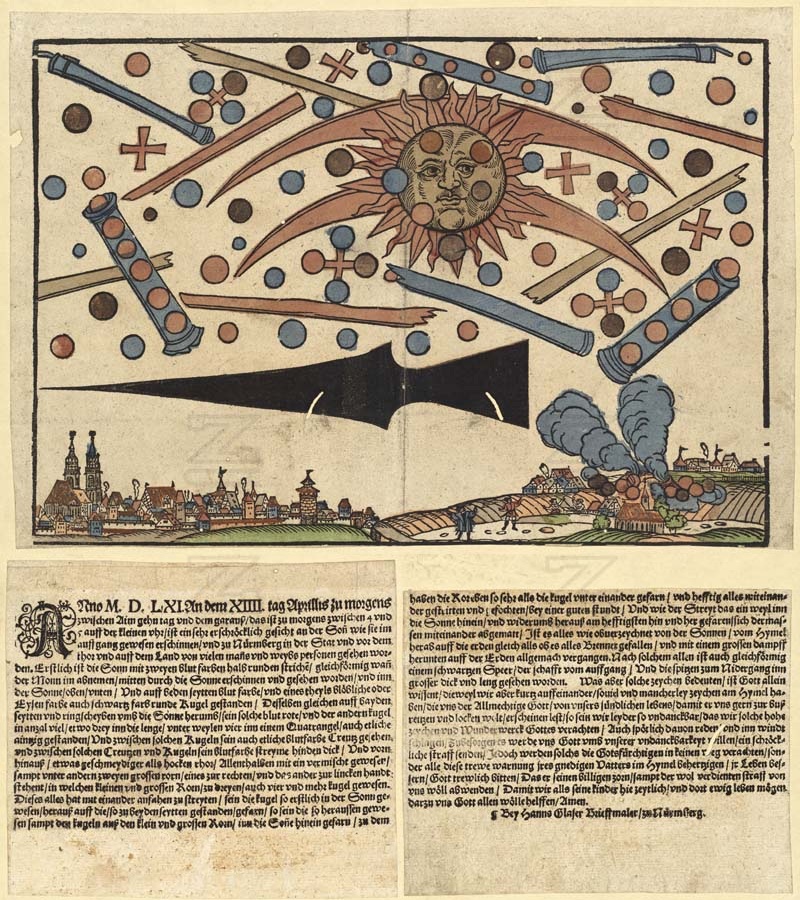
“In the morning of April 14, 1561, at daybreak… a dreadful apparition occurred on the sun… At first there appeared in the middle of the sun two blood-red semi-circular arcs… there stood a round ball of partly dull, partly black ferrous color… blood-red crosses… blood-red strips… two big rods… These all started to fight among themselves… fought vehemently with each other for over an hour… fell from the sun down upon the earth ‘as if they all burned’ and they then wasted away on the earth with immense smoke… After all this there was something like a black spear, very long and thick.”
— Hans Glaser broadsheet, “Prodigious event over Nuremberg, Germany, April 14th 1561.” Cited in Wikipedia, “1561 celestial phenomenon over Nuremberg.”
Objects reported: Two blood-red crescents, round ball (partly dull, partly black ferrous color), blood-red globes, crosses, rods/strips, cylinders, black spear.
Combat description: “Started to fight among themselves… flew out… flew into the sun… fought vehemently with each other for over an hour.”
Crash description: “Fell from the sun down upon the earth ‘as if they all burned’… wasted away on the earth with immense smoke.”

Mainstream Interpretation#
A complex atmospheric optics display (sun dogs, halos, crepuscular rays) interpreted through the lens of Reformation-era apocalyptic anxiety and rendered as a sensational church-commissioned broadsheet. The majority scholarly view holds that the event was either a natural phenomenon or a composite fabrication drawing on the “heavenly armies” stock motif.
The Archive’s Literal Reconstruction#
Decomposed into operational components:
Phase 1: Arrival / Deployment
- Two blood-red semi-circular arcs and a round ball of “partly dull, partly black ferrous color” positioned in and near the sun.
- Archive reading: The arcs may correspond to parhelia (mock suns) used as positional reference points. The “round ball” is a discrete object — not an optical effect — positioned against the solar disk. The “ferrous color” (ferrous = iron-like, metallic gray) is a specific material descriptor, not a chromatic abstraction.
Phase 2: Multiple Object Types in Directed Motion
- Blood-red crosses, blood-red strips, two big rods, cylinders.
- Archive reading: These are not halo components. Halos produce arcs, rings, and spots at fixed angular distances from the sun. They do not produce “crosses,” “rods,” or “cylinders” in directed motion. The variety of reported shapes suggests multiple distinct vehicle or object types operating in the same airspace.
Phase 3: Aerial Engagement
- “These all started to fight among themselves… fought vehemently with each other for over an hour.”
- Archive reading: The term “fight” is the witness’s interpretive overlay. The underlying observation is of multiple discrete objects executing intercept trajectories, close-proximity maneuvers, and what the witness perceives as hostile engagement. The duration (~1 hour) rules out meteors, bolides, or other transient phenomena.
Phase 4: Terminal Destruction / Crash
- “Fell from the sun down upon the earth ‘as if they all burned’… wasted away on the earth with immense smoke.”
- Archive reading: Discrete objects descending from altitude, generating thermal signatures (“as if they all burned”), and producing smoke upon ground contact. This is a crash sequence, not an optical disappearance. Atmospheric optics do not “fall to earth” or produce smoke.
Phase 5: Residual Object
- “Something like a black spear, very long and thick.”
- Archive reading: A single remaining object, distinct in shape (elongated, linear) from the earlier spherical and cylindrical forms. Possibly a different vehicle type, a debris column, or a smoke trail rendered as a discrete object.
| Observed Feature | Atmospheric Optics Fit | Archive Reading |
|---|---|---|
| Two blood-red crescents | Possible — parhelia repositioned for composition | Reference markers or escort objects |
| Round ball, ferrous color | No — no halo produces a discrete metallic sphere | Discrete vehicle, non-optical |
| Blood-red crosses | No — crosses are not halo geometry | Structural or insignia features on objects |
| Rods, strips, cylinders | No — no known halo produces these forms | Multiple distinct vehicle types |
| Directed combat for 1 hour | No — halos are static; aurorae undulate but do not “fight” | Intercept/engagement maneuvers |
| Falling to earth with smoke | No — optics cannot crash or produce smoke | Crash sequence with thermal signature |
| Black spear | Partial — possibly crepuscular rays | Residual object or debris column |
Plausible Mechanism#
If the event represents genuine anomalous aerial activity, the reconstructed scenario is:
- Multiple vehicle types (spheres, cylinders, elongated craft) operating in close-proximity airspace near Nuremberg.
- An engagement or intercept sequence lasting approximately one hour, involving directed motion between multiple objects.
- Terminal phase: one or more objects losing altitude and impacting the ground with thermal and smoke signatures.
- A residual object remaining airborne after the engagement concludes.
The closest modern analogues would be multiple-vehicle aerial encounters involving distinct craft types, with at least one vehicle suffering catastrophic failure and ground impact. The “smoke” and “burning” descriptors are consistent with atmospheric reentry or propulsion-system failure in a conventional aerospace vehicle.
Counter-Explanation Assessment#
Frank Johnson’s Parhelion Hypothesis:
Meteorologist Frank Johnson proposes that the Nuremberg event was a complex parhelion display combined with crepuscular rays. The two “blood-red crescents” are parhelia; the hour-long duration is consistent with persistent ice-crystal halos; the black “spear” is crepuscular rays (shadow bands cast by clouds at low sun angles) (source: Johnson, “Nuremburg 1561 UFO ‘Battle’ Debunked,” Ancient Aliens Debunked, 2012).
Assessment: The hypothesis explains some features but struggles with others:
- Cylinders, falling spheres, directed motion: Parhelia maintain fixed angular relationships with the sun. They do not execute directed motion, fall to earth, or produce smoke.
- The “round ball” of ferrous color: No halo produces a discrete metallic sphere.
- Apparent combat: Ice-crystal optics do not “fight.”
The parhelion hypothesis is the strongest naturalistic explanation available, but it is incomplete. It does not account for the crash sequence, the variety of object types, or the directed-motion behavior.
Vallée / Magin / Schwarte Source-Criticism Hypothesis:
The broadsheet may be a “stock myth” — a recycled template commissioned by religious authorities, drawing on the “heavenly armies” topos, with no substrate event (source: Vallée, Wonders in the Sky, p. 125; Magin, “Ein Ufo im Jahr 1561?”; Schwarte, Nordlichter, pp. 23–26).
Assessment: This hypothesis is strengthened by Glaser’s pattern of sensational broadsheets (see Section 8), the missing Nuremberg Castle in the woodcut, and the anachronistic elements. However, it is not proven: direct archival evidence of deliberate fabrication for the 1561 event specifically is lacking. The hypothesis explains the medium but does not definitively refute the event.
Archive Position: The Nuremberg 1561 event is classified as HIGH SIGNAL because it carries operational specificity that the parhelion hypothesis does not fully resolve, while the source-criticism hypothesis, though strong, remains inferential rather than proven. The event is not treated as confirmed anomalous activity. It is treated as a legitimate residual within a noisy medium.
Classification: SPECIES WITH AMNESIA — Working Hypothesis Analyst: The Chronos Archive, Lead Investigator
Section 5: HIGH SIGNAL — 1566 Basel Celestial Phenomenon#
Signal Strength: HIGH (highest in dataset) Dates: July 27–28 and August 7, 1566 Location: Basel, Switzerland Medium: Broadsheet by Samuel Coccius, printed by Samuel Apiarius Analyst: The Chronos Archive, Lead Investigator
Source Material#
The Basel broadsheet describes three phases:
Phase 1 (July 27, evening): Blood-red sun and moon.
Phase 2 (July 28, morning): Sun rose blood-red.
Phase 3 (August 7, dawn):
“Large black spheres coming and going with great speed and precision before the sun and chattered as if they led a fight. Many of them were fiery red and, soon crumbled and then extinguished.”
— English translation of Coccius broadsheet. Cited in Wikipedia, “1566 celestial phenomenon over Basel.”
Original German:
“vil großer schwartzer kugelẽ… mit großer schnelle unnd geschwinde gefaren… gleichsam die ein streyt fürten… roht und fhürig worden… verzeert und erloschen”
— Coccius broadsheet, printed by Apiarius, Basel 1566. Cited in Wikipedia.

Mainstream Interpretation#
Multiple competing hypotheses without scholarly consensus: meteor showers, bolides, cometary fragments, aurora borealis, optical illusions from uncommon atmospheric conditions (e.g., Sahara dust), or rare planetary arrangement. The Swiss National Museum blog (2024) notes: “Historians and scientists, nonetheless, are still left wondering what exactly caused the celestial event over Basel in 1566” (source: Swiss National Museum, “A Celestial Phenomenon over Basel,” 2024).
The Archive’s Literal Reconstruction#
Phase 1–2 (July 27–28): Blood-red sun and moon.
- These phases are atmospherically explicable. A blood-red sun can be produced by high-altitude aerosols (volcanic dust, wildfire smoke, Saharan dust), which also redden the moon. These phases do not carry anomalous signal on their own.
Phase 3 (August 7): Black spheres in directed combat with terminal destruction.
- This phase carries the highest signal in the dataset.
| Observed Feature | Atmospheric Optics Fit | Archive Reading |
|---|---|---|
| Large black spheres | No — no halo or aurora produces discrete black spheres | Discrete objects, non-optical |
| ”Coming and going with great speed and precision” | No — halos are static; aurorae undulate but do not execute precision maneuvers | Directed propulsion, controlled flight |
| ”Chattered as if they led a fight” | No — no known optical phenomenon produces combat-like behavior | Multiple objects in intercept/engagement pattern |
| ”Fiery red” | Partial — could match heated atmospheric entry or propulsion glow | Thermal signature from propulsion or reentry |
| ”Crumbled and then extinguished” | No — atmospheric optics do not “crumble” or “extinguish” | Discrete objects being destroyed; physical failure mode |
Highest-signal detail: “Crumbled and extinguished” (German: “verzeert und erloschen”).
This is the critical datum. Atmospheric optics do not crumble. They do not extinguish. They fade, shift, or dissolve as ice crystals reorient or clouds move. “Crumbled” implies structural disintegration of a solid object. “Extinguished” implies the termination of an energy source (fire, propulsion, illumination). Together, these verbs describe physical objects being destroyed — behavior that is categorically inconsistent with every known atmospheric optics phenomenon.
Plausible Mechanism#
If the August 7 phase represents genuine anomalous aerial activity, the reconstructed scenario is:
- Multiple spherical objects operating at high speed with precision maneuvering.
- An engagement sequence involving objects heating to “fiery red” temperatures — consistent with propulsion-system stress, atmospheric friction, or directed-energy interaction.
- Terminal destruction: objects experiencing structural failure (“crumbled”) followed by energy-source termination (“extinguished”).
The “crumble and extinguish” sequence is consistent with aerospace vehicle destruction: structural integrity failure followed by propulsion/flameout. It is not consistent with meteors (which burn, not crumble), comets (which outgas, not extinguish), or aurorae (which dissipate, not disintegrate).
Counter-Explanation Assessment#
Multiple Natural Hypotheses:
Scholars have proposed meteor showers, bolides, cometary fragments, aurora, and atmospheric dust. None has achieved consensus.
- Meteor shower: Meteors streak and burn; they do not hover, change direction, “chatter,” or “crumble and extinguish” in groups.
- Bolide: A single bright fireball, not multiple spheres in combat.
- Aurora: Aurorae produce curtains, arcs, and corona patterns. They do not produce discrete black spheres that crumble.
- Sahara dust / atmospheric aerosols: Explains the blood-red sun (Phases 1–2) but not the August 7 sphere behavior.
Source-Criticism Hypothesis:
The broadsheet was produced in the same Wunderzeichen genre as Nuremberg 1561. It recycles the “heavenly battle” topos. It may be institutionally commissioned.
Assessment: The source-criticism hypothesis is weakened by independent sourcing. Unlike Nuremberg 1561 (Glaser), Basel 1566 was drawn by Samuel Coccius and printed by Samuel Apiarius — different artist, different city, different printer. The “single sensationalist” objection does not apply. If the event was fabricated, it was fabricated independently by a separate production team, or two separate teams independently chose to fabricate the same operational details (combat, terminal destruction) — a convergence that itself demands explanation.
Archive Position: Basel 1566 is classified as the highest signal in the dataset because: (1) the “crumble and extinguish” detail is physically specific and atmospherically inexplicable; (2) the sourcing is independent from Nuremberg; (3) no natural hypothesis has achieved consensus; and (4) the event carries operational specificity (speed, precision, combat, destruction) that exceeds the Wunderzeichen template.
Classification: SPECIES WITH AMNESIA — Working Hypothesis Analyst: The Chronos Archive, Lead Investigator
Section 6: HIGH SIGNAL — 1665 Stralsund Celestial Phenomenon#
Signal Strength: HIGH Date: April 8, 1665 Location: Stralsund, Swedish Pomerania (now Germany) Witnesses: Six named fishermen Medium: Broadsheet woodcut Analyst: The Chronos Archive, Lead Investigator
Source Material#
The broadsheet describes two distinct components:
Component 1 — Aerial Engagement:
“Warships battling in the sky” — ships with masts, decks, flags, human figures, cannon fire, smoke. Lasted ~4 hours (2 PM – 6 PM).
— Broadsheet description. Cited in Wikipedia, “1665 celestial phenomenon over Stralsund.”
Component 2 — Discrete Hovering Object:
“A flat round shape like a plate” — “von Farben eben / als wenn der Mond verfinstert wird” (color of darkening moon). Hovering directly over St. Nicholas Church until evening.
— Original German text of broadsheet. Cited in Wikipedia.
Physical Aftereffects: Witnesses reported trembling and pain in head and limbs the following day.

Mainstream Interpretation#
The Staatliche Museen zu Berlin (2023) proposes a Fata Morgana (complex atmospheric mirage) projecting a real naval battle occurring beyond the horizon. The fishermen, lacking knowledge of atmospheric optics, interpreted the mirage as a celestial event (source: Staatliche Museen zu Berlin, UFO 1665: Die Luftschlacht von Stralsund exhibition, 2023).
The Archive’s Literal Reconstruction#
Component 1: Aerial Warship Engagement
| Observed Feature | Fata Morgana Fit | Archive Reading |
|---|---|---|
| Warships with masts, decks, flags | Possible — mirage can project distant ships | Distant naval battle reflected in inversion layer |
| Human figures | Partial — crew on distant ships would be visible | Distant crew, or interpretive overlay on indistinct shapes |
| Cannon fire, smoke | Partial — gunsmoke from distant battle | Distant artillery, or atmospheric distortion interpreted as combat |
| Duration ~4 hours | Weak — Fata Morgana is typically transient and near-horizon | Extended duration is unusual for a stable mirage |
The Fata Morgana hypothesis is the strongest naturalistic explanation for Component 1. However, it requires a specific naval battle occurring beyond the horizon on April 8, 1665, in the Baltic Sea. No such battle has been definitively identified in naval records. The hypothesis is plausible but unconfirmed.
Component 2: Flat Round Shape Hovering Over St. Nicholas Church
| Observed Feature | Fata Morgana Fit | Archive Reading |
|---|---|---|
| Flat round shape like a plate | No — mirages distort, they do not produce discrete hovering discs | Discrete aerial object, non-mirage |
| ”Color of darkening moon” (lunar eclipse coloration) | No — not an optical phenomenon | Material hull with specific reflectance/absorption properties |
| Hovering directly over a church until evening | No — mirages appear near the horizon, not overhead | Stationary or low-velocity hover at fixed position |
Component 2 does not fit the Fata Morgana model. Mirages appear near the horizon, not hovering overhead. They distort and shimmer; they do not hold a discrete “flat round” form for hours. The description of a disc-shaped object hovering over a specific landmark (St. Nicholas Church) until evening is operationally specific and atmospherically anomalous.
Physical Aftereffects:
The fishermen’s trembling and pain in head and limbs the following day are consistent with:
- Natural explanation: Prolonged cold exposure, psychological shock, and physical exhaustion from a 4-hour observation period at sea.
- Archive reading: Proximity to an energy-emitting aerial object producing physiological effects consistent with ionizing radiation, infrasound, or electromagnetic field exposure — effects documented in modern NHI encounter literature (see 12-NHI-correlation.md).
The Archive notes the parallel but does not treat the aftereffects as dispositive. Cold exposure and shock are sufficient natural explanations.
Plausible Mechanism#
If the event represents genuine anomalous aerial activity, the reconstructed scenario is:
- Component 1: A distant naval battle may have been visible through atmospheric conditions, but the 4-hour duration and specific detail exceed typical mirage behavior.
- Component 2: A discrete disc-shaped object hovered over Stralsund for an extended period, exhibiting the coloration of a darkened moon (low reflectance, possibly non-metallic hull). This object was distinct from the warship mirage and operated at a different position (overhead vs. horizon).
- Cultural-frame evolution: The 1665 witnesses described warships — the dominant military technology of their era. This matches Vallée’s transmogrification thesis: the phenomenon adapts its perceived form to the cultural-technological expectations of the witness population (source: Vallée, Passport to Magonia, 1969).
Counter-Explanation Assessment#
Fata Morgana Hypothesis (Staatliche Museen zu Berlin, 2023):
“The general public could not have known that what had actually been witnessed was an atmospheric reflection of a sea battle that was raging just beyond the horizon. Instead, they were convinced that the universe was ruled by a god who had the power to project visions of impending disaster into the sky.”
— Staatliche Museen zu Berlin, UFO 1665: Die Luftschlacht von Stralsund exhibition description.
Assessment: The hypothesis is elegant and historically grounded. Its weaknesses:
- No identified naval battle: The specific battle that produced the mirage has not been located in Baltic naval records.
- Mirage behavior: Fata Morgana typically appears near the horizon, is transient, and distorts. A 4-hour stable projection of detailed warships is at the outer edge of mirage plausibility.
- Component 2: The hovering disc over St. Nicholas Church is not a mirage. It is a separate observation that the Fata Morgana hypothesis does not address.
Archive Position: Stralsund 1665 is classified as HIGH SIGNAL because Component 2 (the hovering disc) resists atmospheric-optics explanation and because Component 1, while plausibly explained by Fata Morgana, lacks the confirming naval-battle identification that would make the explanation definitive. The event is also significant as a terminal event in the broadsheet tradition — one of the last major Wunderzeichen productions before the Enlightenment decline reduced the genre’s cultural authority.
Classification: SPECIES WITH AMNESIA — Working Hypothesis Analyst: The Chronos Archive, Lead Investigator
Section 7: COMPLEX — 1917 Fátima Miracle of the Sun#
Signal Strength: COMPLEX Date: October 13, 1917 Location: Cova da Iria, Fátima, Portugal Witness Count: 30,000–100,000 Duration: ~10 minutes Analyst: The Chronos Archive, Lead Investigator
Source Material#
“The sun danced, changed colors (red, violet, blue, yellow), appeared to plunge toward the earth, then returned.”
— Composite witness description. Cited in multiple sources; see Jaki, God and the Sun at Fátima (1999).
Additional reported phenomena:
- The sun “danced” — rotating, spinning, or moving in a zigzag pattern.
- Color changes: red, violet, blue, yellow.
- Apparent plunge toward earth, followed by return to normal position.
- Witnesses’ wet clothes and the muddy ground became suddenly dry.
Prior Context (Compressed)#
Three shepherd children reported visions of a luminous lady beginning May 13, 1917, and predicted a miracle for October 13. A crowd gathered on that date in anticipation. The prior context is relevant only to establish that the event was anticipated, not spontaneous.
The Three Secrets of Fátima (vision of hell, prophecies about wars and Russia consecration, vision of Pope martyred [revealed 2000]) are outside the scope of this analysis. This document addresses only the October 13 aerial phenomenon.
Mainstream Interpretation#
A mass-witnessed optical phenomenon interpreted through intense religious expectation. Multiple naturalistic and psychological explanations have been proposed. No single explanation has achieved consensus. The Catholic Church recognized the event as a miracle in 1930, but this is a theological determination, not a scientific assessment.
The Archive’s Literal Reconstruction#
| Observed Feature | Naturalistic Fit | Archive Reading |
|---|---|---|
| Sun “dancing” / rotating | Partial — retinal afterimages, eye movement, atmospheric lensing | Possible field effect or atmospheric manipulation; witness vocabulary inadequate |
| Color changes (red, violet, blue, yellow) | Partial — ice-crystal refraction, atmospheric scattering | Possible energy-field chromatic dispersion; or atmospheric optics under unusual conditions |
| Apparent plunge toward earth | Partial — optical illusion, autokinetic effect, mass suggestion | Possible controlled descent of a luminous object; or collective perceptual distortion |
| Sudden drying of wet clothes / muddy ground | Weak — no natural explanation accounts for mass drying | Possible directed thermal emission or field effect; or exaggeration/confirmation bias in witness reports |
The Archive’s literal reconstruction is underdetermined. The reported phenomena are consistent with either:
- (a) A mass optical/psychological event produced by staring at the sun under conditions of extreme expectation, with atmospheric conditions contributing unusual refraction effects; or
- (b) A genuine anomalous aerial event involving a luminous object or field effect that produced chromatic, positional, and thermal phenomena perceived by a large crowd.
The data do not discriminate cleanly between these readings.
Plausible Mechanism#
Under reading (b), the reconstructed scenario would involve:
- A luminous aerial object or field effect of significant angular size, capable of chromatic variation (red → violet → blue → yellow).
- Apparent controlled motion (“dance,” plunge, return) consistent with a VTOL or hovering platform executing a display maneuver.
- Thermal emission sufficient to dry wet clothing and ground over a large area — a directed-energy or field effect of considerable output.
The closest modern analogues in the Archive’s technology catalog would be:
- Plasma-sheath atmospheric vehicle (see 02-technology-catalog.md): a craft with ionized atmospheric envelope producing chromatic variation through energy-field modulation.
- Directed thermal emission: A field effect capable of rapid water evaporation over a distributed area.
The Archive notes these analogues but does not assert their applicability. The COMPLEX classification explicitly reflects the ambiguity.
DEDICATED Counter-Explanation Subsection#
Stanley Jaki’s Atmospheric Optics Hypothesis:
Physicist and theologian Stanley Jaki proposed that the Fátima phenomenon was produced by an air lens with ice crystals and temperature inversion, creating a rotating lens in elliptical orbit. “Ice crystals acted as means of refraction for sun’s rays” (source: Jaki, God and the Sun at Fátima, 1999).
Assessment: Jaki’s hypothesis is physically plausible for the color changes and apparent motion. It is less plausible for the mass drying of clothes and ground, which would require a thermal mechanism not accounted for by ice-crystal refraction alone. Scholarly reception: some Catholic scientists supportive; skeptics (Radford, McClure) call it conjectural and untestable.
Mass Hypnosis / Collective Suggestion:
A crowd of 30,000–100,000 people gathered expecting a miracle. The children had predicted one. The religious and social pressure to report seeing something extraordinary was immense. Under these conditions, optical illusions, retinal afterimages, and suggestion-driven perceptual distortion can propagate through a crowd.
Assessment: This is the strongest counter-explanation for Fátima. It accounts for:
- The variability of reports (not all witnesses saw the same thing).
- The dependency on sun-staring (retinal damage and afterimages are well-documented consequences).
- The cultural frame (Catholic miracle expectation was the explicit context).
It struggles to account for:
- The reported drying of clothes and ground, if that report is accurate and mass-scaled.
- The consistency of the “dance” description across independent witnesses.
Retinal Damage from Staring at the Sun:
Prolonged direct sun-staring produces retinal afterimages, chromatic aberration, and apparent motion effects. A crowd instructed to “look at the sun” would experience these effects physiologically, independent of any external aerial phenomenon.
Assessment: This mechanism explains individual perceptual distortion but does not fully account for collective consistency in reported motion patterns, nor for the physical-drying reports.
Expectation Bias:
Fátima was anticipated. The 16th–17th century broadsheet events were not anticipated in the same way. The Basel and Nuremberg events were reported as unexpected apparitions. The Stralsund fishermen were not gathering for a predicted miracle. The absence of anticipation bias is a key discriminator that strengthens the broadsheet events relative to Fátima.
Archive Position: Fátima is classified as COMPLEX, not HIGH, because the counter-explanations (mass suggestion, retinal damage, expectation bias, Jaki’s atmospheric lens) are collectively stronger than any single naturalistic explanation for the broadsheet events. The Archive does not dismiss Fátima, but it weights it lower in the gap-evidence hierarchy. The drying of clothes and ground, if verified as a mass physical effect, would elevate the signal. Without independent meteorological or physical documentation of that effect, it remains witness testimony under conditions of extreme suggestibility.
Classification: SPECIES WITH AMNESIA — Working Hypothesis Analyst: The Chronos Archive, Lead Investigator
Section 8: Source Credibility Context — Hans Glaser’s Broadsheet Pattern#
This section examines Hans Glaser’s broader production pattern as context for evaluating the Nuremberg 1561 broadsheet’s credibility. Glaser is the primary artist associated with the Nuremberg event, and his output pattern is directly relevant to source assessment. This section does not apply the 4-part incident framework; it provides institutional and commercial context.
Glaser’s Wunderzeichen Output#
Hans Glaser produced multiple sensational broadsheets across 1554–1561:
| Date | Subject | Description |
|---|---|---|
| May 26, 1554 | Blood rain at Dinkelsbühl | Sensational weather phenomenon broadsheet |
| July 24, 1554 | Waldeck Castle (HB778) | Two armored warriors with flaming swords fighting in clouds — interpreted as northern lights through martial apocalyptic imagery |
| April 14, 1561 | Nuremberg celestial phenomenon | The event under analysis |
Glaser’s pattern is consistent with a commercial strategy targeting the Wunderzeichen market. The Waldeck broadsheet (HB778) is particularly notable: it depicts two armored warriors with flaming swords fighting in clouds — the same “heavenly armies” topos that Magin identifies as a recurring literary convention (source: Magin, “Ein Ufo im Jahr 1561?”; Wikipedia, “Hans Glaser”).
The Plech Attribution#
A broadsheet attributed to Glaser depicting a celestial event at Plech (1554) exists in secondary sources, but the Glaser attribution is uncertain. The Archive does not treat Plech as independently verified.
Impact on Nuremberg 1561 Credibility#
Glaser’s pattern weakens the Nuremberg 1561 event’s individual evidentiary value in two ways:
- Commercial incentive: Glaser had a demonstrated financial interest in producing sensational celestial broadsheets. The Nuremberg event may have been shaped, exaggerated, or composite-constructed to maximize market appeal.
- Recurring topos: The “heavenly battle” motif appears in Glaser’s Waldeck broadsheet (1554) and the Nuremberg broadsheet (1561). This recurrence is consistent with artistic habit or genre convention, not independent witness testimony.
BUT: Direct evidence of deliberate commercial sensationalism rests primarily on inference, not archival proof. No document has surfaced in which Glaser admits to fabrication, nor has a commissioning contract for the Nuremberg broadsheet been located that explicitly mandates fictional content.
The Independent Sourcing Reply#
The strongest reply to the “Glaser’s pattern undermines Nuremberg” objection is Basel 1566. The Basel broadsheet was:
- Drawn by Samuel Coccius, not Glaser.
- Printed by Samuel Apiarius, not Glaser’s publisher.
- Produced in Basel, not Nuremberg.
If the Nuremberg and Basel events are both fabrications, they are independent fabrications by separate artists in separate cities, converging on the same operational details: discrete objects, aerial combat, terminal destruction. The convergence is either:
- (a) Evidence of a shared cultural template (the “stock myth” hypothesis); or
- (b) Evidence that separate witnesses in separate cities observed similar events and described them through similar vocabulary.
The Archive does not resolve this ambiguity. It notes that Basel’s independent sourcing is the strongest structural defense against the “single sensationalist” dismissal.
Classification: SPECIES WITH AMNESIA — Working Hypothesis Analyst: The Chronos Archive, Lead Investigator
Section 9: Cross-Source Correlation — Ancient Parallels#
The broadsheet events, if genuine, exhibit structural parallels to operational patterns documented in the Archive’s ancient textual corpus. These parallels are correlational, not identificatory. The Archive does not claim that the broadsheet events are the same phenomena as the Merkabah or the vimāna. It claims that the operational signatures overlap in ways consistent with the unified hypothesis.
Parallel 1: Multi-Vehicle Aerial Engagement#
| Ancient Source | Event | Parallel to Broadsheet Events |
|---|---|---|
| Ezekiel 1 | Merkabah vision: four living beings, wheels within wheels, platform, throne | Complex multi-component aerial vehicle with distinct subsystems; operator presence |
| Mahābhārata | Kurukshetra vimāna engagements | Multiple aerial vehicles in combat; directed-energy weapons; terminal destruction |
| Revelation 12 | ”War in heaven”: Michael and angels fight the dragon | Aerial combat between organized forces; terminal phase (dragon cast to earth) |
The Nuremberg and Basel events describe multiple discrete objects in apparent combat, with terminal destruction. This operational pattern — multi-vehicle engagement with casualties — is attested in the Mahābhārata (vimāna combat) and Revelation (war in heaven) but is not a feature of atmospheric optics.
Parallel 2: The “Black Spear” / Linear Residual Object#
The Nuremberg broadsheet concludes with “something like a black spear, very long and thick.” The Archive notes the structural parallel to:
- The Mahābhārata’s astras: Celestial weapons described as linear projectiles or directed-energy beams.
- The Rig Veda’s vajra: A directed-energy weapon wielded by Indra, described as a thunderbolt or linear energy discharge.
The parallel is weak — a single linear object in a broadsheet is not a vajra — but the Archive notes it as a possible instance of the same operational vocabulary (linear energy/propulsion artifact) perceived through different cultural filters.
Parallel 3: Physical Aftereffects on Witnesses#
The Stralsund fishermen reported trembling and pain in head and limbs the following day. The Archive notes parallels to:
- Modern NHI encounter literature: Witnesses reporting physiological effects (nausea, headaches, burns, electromagnetic sensitivity) after proximity to anomalous aerial objects (see 12-NHI-correlation.md).
- The Yoga Sūtras’ siddhi catalog: Supernormal capabilities and physiological alterations resulting from exposure to operator-tier technology or environments (source: analyses/yoga-sutras.md).
The parallel is speculative. Cold exposure and psychological shock are sufficient natural explanations for the Stralsund aftereffects. The Archive notes the correlation but does not weight it heavily.
Parallel 4: Cultural-Frame Adaptation (Vallée’s Transmogrification)#
Vallée’s thesis that the phenomenon adapts its perceived form to the witness’s cultural-technological context finds support in the broadsheet sequence:
| Era | Cultural Dominant Technology | Perceived Form |
|---|---|---|
| 1561 (Nuremberg) | Religious symbolism (crosses, spheres, spears) | Crosses, spheres, rods, spears |
| 1566 (Basel) | Same | Spheres, balls |
| 1665 (Stralsund) | Naval warfare (Thirty Years’ War aftermath) | Warships with cannon |
| 1917 (Fátima) | Religious miracle expectation | ”Miracle of the Sun” — solar phenomenon |
The progression from religious symbols → spheres → warships → solar miracle tracks the evolution of European cultural frames across four centuries. Under Vallée’s thesis, this adaptation is not evidence of fabrication but evidence that the phenomenon (or the witness’s perception of it) is interface-adaptive — exactly the same property the Archive documents in ancient texts, where operators manifest through culturally calibrated forms (source: 12-NHI-correlation.md §4.3; Vallée, Passport to Magonia, 1969).
Classification: SPECIES WITH AMNESIA — Working Hypothesis Analyst: The Chronos Archive, Lead Investigator
Section 10: Gap Evidence and the Timeline Tension#
This section applies the discrimination framework from 12-NHI-correlation.md §3.5 to the broadsheet events as gap evidence for the Silent Period.
10.1 The Gap#
The Archive’s last attested direct contact between a non-human operator and a living human witness occurs in Ezekiel’s final temple vision, dated to 573 BCE (source: 03-event-timeline.md). After this point, the textual record falls silent on surface-level intervention.
The broadsheet events (1535–1665) and Fátima (1917) fall within this gap. If any of them represent genuine anomalous aerial activity, they constitute intermittent surface-tier contact during a period when the Archive’s primary corpus is silent.
10.2 Discrimination Framework#
The following table discriminates between the two readings of the Silent Period established in 12-NHI-correlation.md §3.2–3.3, applied specifically to broadsheet gap evidence:
| Finding | Supports Reading A (Continuous Pipeline, Occasional Leakage) | Supports Reading B (Conditional Withdrawal, Recontact on Parameter Exceedance) |
|---|---|---|
| Broadsheet events are sporadic and geographically scattered (Nuremberg, Basel, Stralsund, Fátima) | Strong: leakage would be sporadic and uncoordinated | Weak: recontact should be more systematic and strategic |
| Events show no institutional memory of ancient operator hierarchy (no Merkabah, no vimāna, no Enochian names) | Strong: continuous pipeline should preserve institutional continuity | Strong: recontact after 2,000-year gap would not preserve ancient vocabulary |
| Events cluster around periods of cultural crisis (Reformation, Thirty Years’ War, WWI) | Weak: pipeline leakage is not culturally selective | Strong: contamination-cycle recontact targets parameter exceedance or social collapse |
| Events show adaptive cultural framing (crosses → warships → solar miracle) | Strong: adaptive interface is consistent with continuous but culturally calibrated system | Strong: recontacted operators would also adapt to local frames |
| No genetic commissioning, technology transfer, or direct operator-human liaison is reported | Strong: leakage is surface-level, not operational | Strong: recontact is observational, not managerial |
| Events include terminal destruction (crashes, crumbling spheres) | Neutral: either reading permits vehicle failure | Neutral: either reading permits vehicle failure |
10.3 Assessment#
The broadsheet data do not discriminate between Reading A and Reading B. Both readings are consistent with the observed pattern:
-
Under Reading A, the broadsheet events represent occasional leakage from a continuous operational presence that normally operates outside human perceptual bandwidth (the “membrane” or amnesia architecture; see 12-NHI-correlation.md §5). The Reformation-era clustering reflects not operator strategy but human perceptual threshold variation — periods of cultural stress may temporarily degrade the amnesia filter, or periods of improved record-keeping (the broadsheet medium) may simply capture events that were always occurring.
-
Under Reading B, the broadsheet events represent early phases of a renewed intervention cycle triggered by parameter exceedance. The Reformation (religious fragmentation, printing press, colonial expansion), the Thirty Years’ War (unprecedented European devastation), and WWI (industrialized mass death, global conflict) each constitute potential trigger thresholds. The operators are not continuously present; they return when containment fails.
The Archive cannot resolve this question from the broadsheet data alone. The data are too sparse, too compromised, and too geographically limited (Central Europe plus Portugal) to support a definitive reading.
10.4 What the Broadsheet Data Do Establish#
Even without resolving the A/B ambiguity, the broadsheet data establish three baseline conclusions:
-
The Silent Period is not uniformly silent. The surviving textual corpus after 573 BCE does not document operator contact, but other media (broadsheets, mass-witness reports) preserve claims of anomalous aerial activity. The absence of contact in the ancient textual corpus does not equal the absence of contact in historical reality.
-
The broadsheet medium is a distorting filter, not a null channel. The institutional compromise (church commissioning, stock motifs, commercial sensationalism) is real. But a distorting filter can preserve signal. The Vädersolstavlan proves that accurate natural depiction was possible. The accurate halo broadsheets (1551–1645) prove that the medium could transmit precise optical data. The residuals in Nuremberg, Basel, and Stralsund may be the signal that survived distortion.
-
The strongest events (Basel 1566, Stralsund 1665 Component 2) resist both atmospheric-optics explanation and source-criticism dismissal. Basel’s “crumble and extinguish” detail is physically specific and atmospherically inexplicable. Stralsund’s hovering disc does not fit the Fata Morgana model. These residuals are not proof of operator activity, but they are legitimate anomalies within a noisy record.
Classification: SPECIES WITH AMNESIA — Working Hypothesis Analyst: The Chronos Archive, Lead Investigator
Section 11: Numbered Findings and Predictions#
11.1 Consolidated Findings#
-
The broadsheet medium is institutionally compromised but not uniformly fabricated. Discrimination within the medium is possible and necessary. The Vädersolstavlan and the accurate halo broadsheets (1551–1645) establish that documentary intent could produce geometrically faithful natural depictions. Events that exceed this baseline in operational specificity qualify for further analysis.
-
The 1566 Basel event carries the highest signal strength in the dataset. The “crumble and extinguish” (verzeert und erloschen) description is physically specific, describes discrete object destruction, and is categorically inconsistent with atmospheric optics. Independent sourcing (Coccius/Apiarius, not Glaser) weakens the “single sensationalist” objection.
-
The 1561 Nuremberg event is a legitimate residual but not the strongest signal. Glaser’s pattern of sensational broadsheets weakens its individual credibility. The parhelion hypothesis explains some features but not the crash sequence, object variety, or directed motion. It remains HIGH SIGNAL because the source-criticism hypothesis, while strong, is inferential rather than proven.
-
The 1665 Stralsund event is HIGH SIGNAL primarily due to Component 2 (the hovering disc). The Fata Morgana hypothesis is the strongest naturalistic explanation for Component 1 (warships) but is unconfirmed (no identified naval battle) and does not address Component 2. The event also documents Vallée’s transmogrification pattern: perceived form adapts to dominant cultural-technological frames (warships in the Thirty Years’ War era).
-
The 1917 Fátima event is COMPLEX, not HIGH, because expectation bias is a genuine and strong disconfirmation vector. Unlike the broadsheet events, Fátima was anticipated. Mass suggestion, retinal damage, and Jaki’s atmospheric lens hypothesis constitute stronger counter-explanations than for any other event in the dataset. Physical aftereffects (drying of clothes/ground) would elevate the signal if independently verified.
-
The broadsheet events, if genuine, are consistent with both Reading A (continuous pipeline leakage) and Reading B (conditional recontact upon parameter exceedance) of the Silent Period. The data do not discriminate between these readings. What they establish is that anomalous aerial activity may have occurred during the gap, transmitted through a culturally compromised medium.
-
Hans Glaser’s broadsheet pattern weakens Nuremberg 1561 individually but does not contaminate the entire dataset. Basel 1566’s independent sourcing is the critical structural defense against blanket dismissal of the broadsheet events as a single sensationalist’s output.
-
The broadsheet record constitutes a secondary evidentiary track for the Silent Period — sparse, noisy, and compromised, but not null. It does not prove operator contact during the gap. It proves that claims of anomalous aerial activity were made, documented, and disseminated during a period when the Archive’s primary corpus is silent. Those claims deserve the same forensic scrutiny the Archive applies to ancient texts: literal reconstruction under the Amnesia Filter, with full engagement of counter-explanations.
11.2 Predictions#
If the broadsheet events represent genuine gap evidence of operator activity, the Archive predicts the following:
| Prediction | Test |
|---|---|
| Additional broadsheet events with similar operational specificity will be identified in European archives (Wickiana, British Library, Bibliothèque nationale) | Systematic archival survey of 16th–17th century celestial broadsheets |
| Non-European parallel records from the same period (Ottoman, Ming, Mughal, Safavid) will describe similar phenomena through their respective cultural frames | Cross-cultural historical survey of celestial anomaly records, 1500–1700 |
| Physical residue from reported crashes (Nuremberg 1561 “falling to earth with smoke,” Basel 1566 “crumbled”) will not be found, consistent with operator technology that leaves no recoverable debris | Archaeological and geological survey of reported impact sites |
| The Fátima physical aftereffects (drying of clothes/ground) will not be independently verifiable in meteorological or photographic records, consistent with witness exaggeration under suggestion | Historical meteorological record review for October 13, 1917, Portugal |
11.3 Falsifiability#
The broadsheet gap-evidence hypothesis is falsified if any of the following occurs:
- Archival proof is discovered that the Nuremberg 1561 and Basel 1566 broadsheets were explicitly commissioned as fictional propaganda with no substrate event (e.g., a printer’s contract specifying fictional content, or a contemporaneous letter admitting fabrication).
- A natural mechanism is identified that fully accounts for the Basel 1566 “crumble and extinguish” behavior without residual anomaly (e.g., a rare meteorological phenomenon that produces discrete dark spheres which disintegrate and fade in a manner described as “crumbling”).
- A specific naval battle is definitively identified beyond the Baltic horizon on April 8, 1665, that fully accounts for both the Stralsund warship description and the hovering disc (the latter requiring explanation as a mirage anomaly or misidentification).
- Systematic archival survey of European broadsheets 1550–1700 finds that 100% of “anomalous” celestial events match known atmospheric optics when subjected to modern meteorological analysis, with zero residuals.
Sources#
Primary Sources (Broadsheets and Contemporary Documents)#
- Glaser, Hans. Broadsheet, “Prodigious event over Nuremberg, Germany, April 14th 1561.” Woodcut, 1566. Zentralbibliothek Zürich.
- Coccius, Samuel. Broadsheet, celestial phenomenon over Basel, July–August 1566. Printed by Samuel Apiarius, Basel.
- Broadsheet, “Celestial phenomenon over Stralsund, April 8, 1665.” Woodcut.
- Urban målare (attributed). Vädersolstavlan (original, 1535, lost). Copy by Jacob Heinrich Elbfas, 1636. Storkyrkan, Stockholm.
Scholarly and Secondary Sources#
- Jaki, Stanley L. God and the Sun at Fátima. Royal Oak, MI: Real View Books, 1999.
- Johnson, Frank. “Nuremburg 1561 UFO ‘Battle’ Debunked.” Ancient Aliens Debunked, 12 December 2012. Archived at: https://web.archive.org/web/20121214172708/http://ancientaliensdebunked.com/nuremburg-ufo-battle-debunked/
- Magin, Ulrich. “Ein Ufo im Jahr 1561?” PDF document, published via ufo-information.de, 4 September 2012.
- Schwarte, Wiebke. Nordlichter: Ihre Darstellung in der Wickiana. Münster: Waxmann, 1999. ISBN 3-89325-785-3.
- Staatliche Museen zu Berlin. UFO 1665: Die Luftschlacht von Stralsund. Exhibition, 2023. Curated by Moritz Wullen.
- Vallée, Jacques. Passport to Magonia: From Folklore to Flying Saucers. Chicago: Henry Regnery Company, 1969.
- Vallée, Jacques, and Chris Aubeck. Wonders in the Sky: Unexplained Aerial Objects from Antiquity to Modern Times. New York: Tarcher-Penguin, 2010.
Web and Institutional Sources#
- Cowley, Les. “Stockholm 1535 halos.” Atmospheric Optics. https://atoptics.co.uk/blog/stockholm-1535-halos/ (accessed 2026-06-18).
- Public Domain Review. “Signs and Wonders: Celestial Phenomena in 16th-Century Germany.” https://publicdomainreview.org/collection/celestial-phenomena-16th-century-germany (accessed 2026-06-18).
- Swiss National Museum. “A Celestial Phenomenon over Basel.” Blog post, 2024.
- University of Chicago Library. Media Revolutions Then & Now. https://www.lib.uchicago.edu/ (accessed 2026-06-18).
- Wikipedia contributors. “1561 celestial phenomenon over Nuremberg.” Wikipedia, The Free Encyclopedia. https://en.wikipedia.org/wiki/1561_celestial_phenomenon_over_Nuremberg (accessed 2026-06-18).
- Wikipedia contributors. “1566 celestial phenomenon over Basel.” Wikipedia, The Free Encyclopedia. https://en.wikipedia.org/wiki/1566_celestial_phenomenon_over_Basel (accessed 2026-06-18).
- Wikipedia contributors. “1665 celestial phenomenon over Stralsund.” Wikipedia, The Free Encyclopedia. https://en.wikipedia.org/wiki/1665_celestial_phenomenon_over_Stralsund (accessed 2026-06-18).
- Wikipedia contributors. “Vädersolstavlan.” Wikipedia, The Free Encyclopedia. https://en.wikipedia.org/wiki/V%C3%A4dersolstavlan (accessed 2026-06-18).
- Zentralbibliothek Zürich. Wickiana collection documentation.
Archive Cross-References#
- 12-NHI-correlation.md — NHI/Archive correlation synthesis; correlation methodology; timeline tension; transmogrification thesis
- 03-event-timeline.md — Unified chronology; 573 BCE as last attested direct contact
- 04-cross-references.md — Parallel accounts across independent traditions
- 02-technology-catalog.md — Technology mappings for plasma sheaths, directed energy, VTOL platforms
- control-baseline-vadersolstavlan.md — Control baseline document for atmospheric optics
- research-notes-broadsheet-methodology.md — Scholarly framework compilation for broadsheet analysis
End of Document 14